


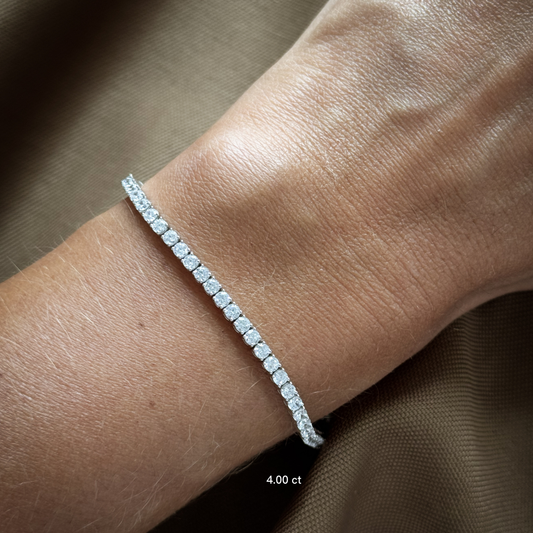


How a tennis bracelet is constructed
A tennis bracelet is a straight, flexible row of identical diamonds that runs all the way around the wrist. Each stone sits in its own small setting, and the settings are hinged together link by link, so the bracelet follows the shape of the wrist and drapes softly around it. It is precisely the unbroken line of equally sized stones that defines the shape and sets it apart from an ordinary chain bracelet with individual stones here and there.
At Longvé there are two ways of setting the stones. In a prong bracelet, each diamond is held by four small claws, so the stone sits slightly raised and catches the light from several angles. In a bezel bracelet, each stone is encircled by a thin metal rim all the way around, which gives a more rounded, modern line and protects the edge of the stone against knocks. If you want to see the two constructions side by side, you can compare across prong jewellery and bezel jewellery.
The name comes from the world of tennis. During the US Open in 1987, the American tennis player Chris Evert lost her diamond bracelet on the court and asked for the match to be paused until she had found it. Ever since, that type of bracelet has been called a tennis bracelet.
Carat determines how bold the row of diamonds appears
The total diamond weight is the single factor that most clearly changes the appearance of a tennis bracelet. Carat (with a c) measures the combined weight of the diamonds, and the higher the number, the larger each individual stone, and the wider and more brilliant the overall line around the wrist becomes.
At Longvé the tennis bracelets range from 1 carat up to 6 carat. A bracelet of 1 to 1.5 carat has fine, closely set stones and a discreet shimmer that suits everyday wear and lends itself to stacking with other jewellery. Around 2 to 3 carat, each stone becomes noticeably larger, and the bracelet stands out clearly on the wrist. From 4 carat and up it is a striking piece of jewellery, where the diamonds fill the width of the wrist and catch the light from a distance.
The same carat number is distributed differently depending on the length of the bracelet: if you choose a shorter size, the total diamond weight sits across fewer centimetres and appears denser, while the same carat on a longer size is spread out a little more. If you are considering primarily the more discreet variants, you will find the 1 carat models among bezel tennis necklace and in the entire collection of tennis bracelets.
Gold or white gold for a tennis bracelet
All tennis bracelets at Longvé are cast in 14 karat (with a k) gold and come in both gold and white gold. The choice mostly comes down to what else you wear, and how you want the diamonds to appear.
Gold gives a warm frame around the diamonds and a classic, mellow contrast between metal and stone. It suits warm skin tones and pairs well with other gold jewellery. White gold is a silvery-white metal that tones down the metal and lets the diamonds stand out more clearly, because the white light of the stones blends together with the setting. If you want a cool, modern look where the light in the stones is the first thing the eye catches, white gold is the obvious choice.
You can explore the two tones separately under gold and white gold. If you are unsure what distinguishes white gold from ordinary gold, what is white gold goes through the difference in detail.
Natural or lab-grown diamonds
Longvé makes each tennis bracelet in two versions: with natural diamonds and with lab-grown diamonds. Both are genuine diamonds of the same material, the same hardness and the same light refraction. The difference lies in where the stone came into being.
A natural diamond is formed deep within the earth over a very long time. A lab-grown diamond is grown in a laboratory under conditions that mimic the same process, but in a shorter time. Chemically and optically the two are indistinguishable to the naked eye, and the difference can only be determined with special equipment. In practice this means that a lab-grown diamond gives you more diamond for your money: for the same budget you can either choose a higher carat weight or spend less on the same size.
If you want to read thoroughly about how they are created, and why they are considered genuine diamonds, what are lab-grown diamonds covers it all. You can also see the entire selection of jewellery with grown stones under lab-grown diamond bracelets.
How to find the right length
The tennis bracelets come in lengths of 15, 16, 17, 18 and 19 cm. The right length depends on your wrist and on how loosely you want the bracelet to sit.
Measure the circumference of your wrist with a tape measure or a strip of paper just below the bone, where a bracelet naturally falls. A tennis bracelet should sit tightly enough that it does not slip over the hand, but loosely enough to turn freely around the wrist. As a rule of thumb, you add about 1 to 2 cm to the wrist measurement to achieve a comfortable fit. If you have a wrist of around 15 cm, a 16 cm model fits as a close-fitting bracelet, while 17 cm gives a little more room to move.
Because the stones sit all the way around, a tennis bracelet is felt more clearly than a thin chain, and many therefore prefer a fit that sits securely without being tight. If you are unsure how best to measure, how long should a bracelet be goes through the procedure step by step.
Prong or bezel for everyday and special occasions
The choice between prong and bezel is about both appearance and how the bracelet holds up to use. In a prong bracelet, each diamond is held by small claws that lift the stone clear of the metal. Light reaches the stone from several sides, and the brilliance becomes sharp and lively. In return, the settings protrude a little more, and this is the classic, traditional tennis bracelet form.
In a bezel bracelet, each stone sits encircled by a smooth metal rim. The surface becomes more even and more rounded, and the rim protects the outermost edge of the diamond from knocking against hard surfaces. This makes bezel an obvious choice if the bracelet is to be worn daily and withstand you using your hands. The look is at the same time a little more contemporary and minimalist.
If you want to see the bezel versions together, you will find them under bezel jewellery, while prong jewellery shows the classic claw setting across categories.
A tennis bracelet as a gift
A tennis bracelet is one of those pieces of jewellery that is often given for a milestone, because it is both personal and lasts the rest of your life. It is classic enough to be worn daily and festive enough to mark a significant birthday, a wedding anniversary or a jubilee.
If you do not know the wrist measurement in advance, a mid-length such as 17 cm is a safe starting point for most adult wrists, and the bracelet can always be exchanged for another length. If it is to be a surprise, a gift card can be the way around the guesswork about size and carat. If you are looking for more gift ideas in the same price range, you can also browse gifts under DKK 10,000.
The tennis bracelet is thematically connected to the tennis necklace, and if you want to give two pieces of jewellery that speak the same language, you can find the matching necklace under bezel tennis necklace. The background to the name itself you can read in why is it called a tennis bracelet.
How to keep the bracelet clean and intact
Diamonds collect skin oils and soap residue, and a thin film on the stones quickly dulls the brilliance. A tennis bracelet with stones all the way around therefore benefits most from regular cleaning. Place it in lukewarm water with a little mild soap, gently brush between the settings with a soft toothbrush, rinse and pat dry. Then the stones catch the light again.
The clasp is the bracelet's most important detail in everyday use. Check that it clicks fully into place every time you put the bracelet on, and make sure the safety lock is closed before you let go. Store the bracelet separately from other jewellery, so the diamonds do not scratch softer metal, and so the chain does not tangle with other chains. More thorough guidance can be found in how to clean jewellery and in how should I store my jewellery.