







Wedding rings for the one who says yes a second time
A wedding ring is worn every day for the rest of your life, and that is why durability and fit matter just as much as the look. The selected wedding rings at Longvé bring together rings in 14K gold and 14K white gold with diamonds set all the way around, halfway around or as a single stone. They come with both lab-grown and natural diamonds in the same design, so the choice of stone does not dictate the choice of model. Here we go through the differences between the ring types, what carat they carry, and how size and metal work together.
Eternity, half eternity or a single stone
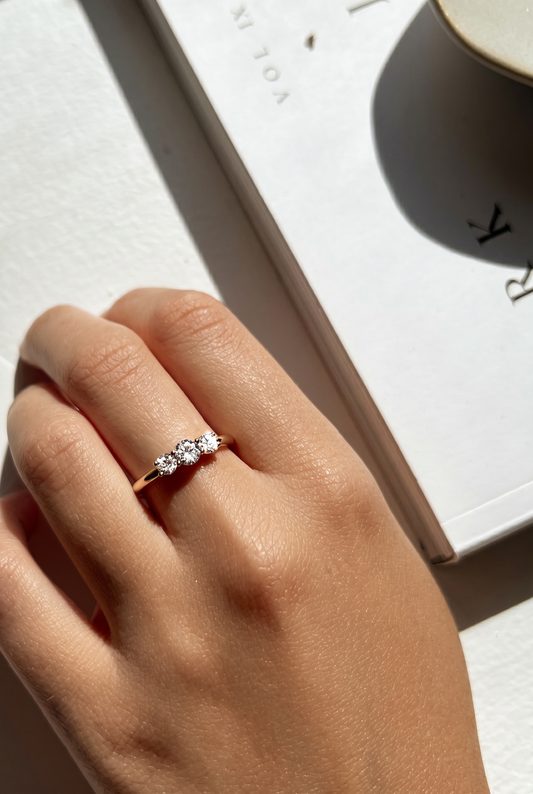
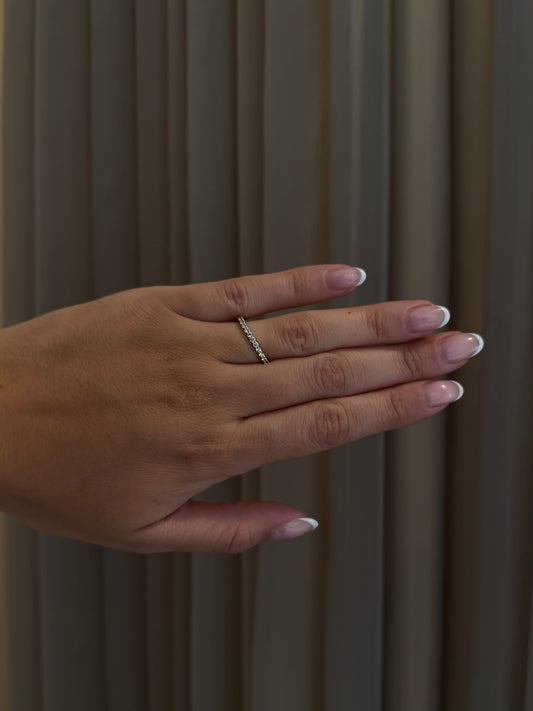
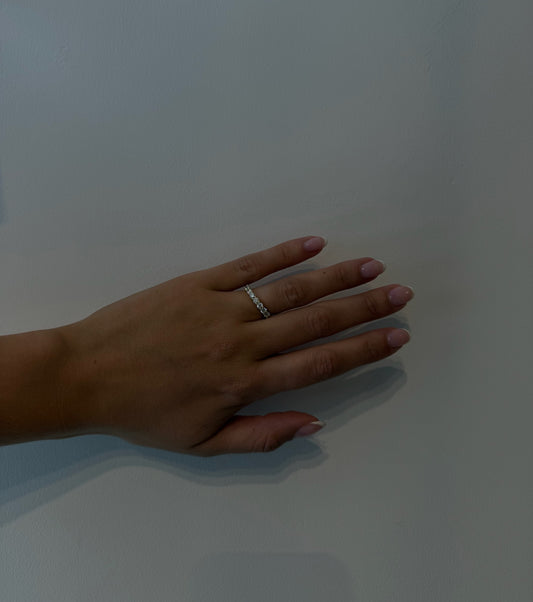
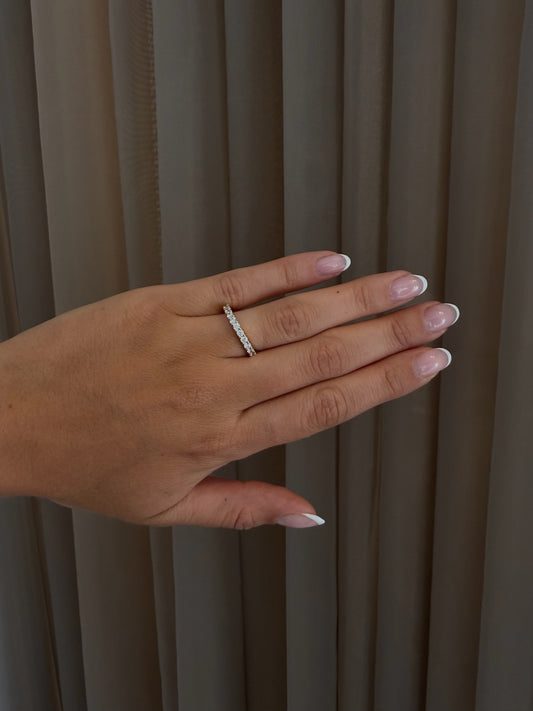
The three basic forms each suit a different taste and daily life. An eternity ring has small diamonds all the way around the band and gives light from every angle, no matter how the hand turns. A half eternity ring has diamonds halfway around, typically on the upper half, so the underside against the finger is smooth metal. That makes it comfortable to wear all day and easier to resize later. A single-stone ring draws attention to one diamond and stays close to the classic solitaire form known from engagement rings.
In practice, the choice comes down to how much the ring should stand on its own, and how much it should work alongside an engagement ring on the same hand. Many people today choose two rings, one engagement ring and one wedding ring, and a half eternity ring or a slim eternity ring sits flat against a solitaire ring without pushing it away from the finger.
How carat ranges from discreet to striking
The selected rings cover a wide range in diamond weight, and the number determines both how much the ring takes up on the hand and how strongly it catches the light. At the discreet end is a tiny half eternity ring at 0.14 ct. and a little wave ring at 0.13 ct., where the stones sit close and fine without taking all the attention.
In the middle you find a small eternity ring at 0.52 ct. and a valley ring at 0.57 ct., which are still easy to wear every day. At the striking end, a large eternity ring goes all the way up to 1 ct. with diamonds all the way around, and a large round prong eternity ring reaches 1.1 ct. with round stones in a prong setting that lift the diamonds up and let more light in from the sides.
Single-stone rings in bezel or pear shape
If you want to focus on one stone rather than a row, there are several single-stone rings among the selected wedding rings. A medium solitaire bezel ring holds its 0.17 ct. diamond in a bezel setting, where the metal surrounds the stone all the way around. This gives a smooth, rounded edge without prongs that can catch on clothing, and it makes the ring robust for daily wear. The same design is also available in 14K white gold.
For a softer, more feminine look there is a pear ring with a pear-shaped diamond of 0.45 ct. The pear shape points its tip toward the fingertip and makes the hand appear long and slender. It also comes in white gold, if you want to match the cool tone of an engagement ring in the same metal.
Wavy and faceted bands for a different look
Not all wedding rings need to be a straight row of stones. A wave ring at 0.43 ct. lets the diamonds follow a soft wave line, so the ring sits with a gentle curve against an engagement ring and ends close up against it. If you want more volume in the wave itself, a bold wave ring goes up to 0.85 ct.
Another route is the faceted band. An eternity emerald ring at 1.01 ct. uses emerald-cut stones with their calm, step-like facets, which give a clearer and more subdued sparkle than the lively glitter of brilliant-cut diamonds. An eternity double ring at 0.4 ct. places two close rows of stones side by side and takes up a little more width without becoming heavy.
14K gold or 14K white gold
The metal determines how the ring suits the skin and how it works together with other rings on the hand. 14K gold has the warm, golden tone that looks beautiful against warm skin tones and suits diamonds with a slight touch of warmth. 14K white gold is cooler and more neutral, and lets a colorless diamond appear completely clear and white.
Several of the selected designs come in both metals, so you can match the wedding ring to an engagement ring you already own. If you want to go in the cool direction, there is among others a pear ring in white gold and a medium solitaire bezel ring in white gold with a natural diamond. If you want to blend the two tones, a golden and a cool ring are worn together deliberately, so they play off each other. The entire selection of rings can be seen among Longvé's rings.
Lab-grown and natural diamonds in the same design
Most of the selected wedding rings come with both lab-grown and natural diamonds in the same model and the same carat. A lab-grown diamond has exactly the same chemical composition and optical properties as a natural diamond and is just as hard, namely 10 on the Mohs scale, so it withstands the daily wear a wedding ring is exposed to. The difference cannot be seen with the naked eye.
This means that the choice between lab-grown diamonds and natural diamonds comes down to budget and preference, not appearance or durability. If you want more carat for the same amount, a lab-grown diamond goes further. If you want to read more about how they are made, there is an overview in the article what are lab-grown diamonds.
Sizes and fit on the wedding ring
Most of the selected wedding rings come in sizes 48 to 60, measured as the ring's inner diameter converted to a European number. A wedding ring should sit tight enough not to slip off, but loose enough to get over the knuckle, and fingers typically swell slightly in heat and later in the day, so it is worth measuring when the hand is warm.
- Size 50 corresponds to an inner diameter of 15.9 millimeters.
- Size 54 corresponds to 17.2 millimeters.
- Size 58 corresponds to 18.5 millimeters.
A half eternity ring with a smooth underside is easier to resize than an eternity ring with stones all the way around, because there is room to work on the underside. If you are unsure about the number, the article how to measure ring size goes through the procedure step by step.