

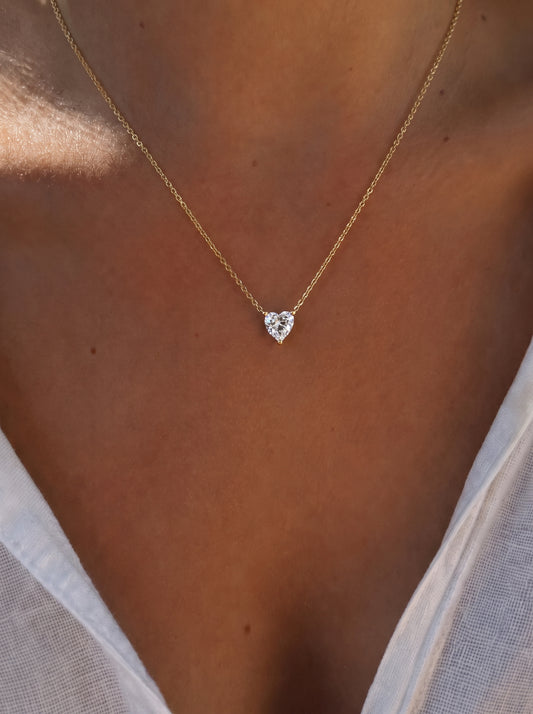

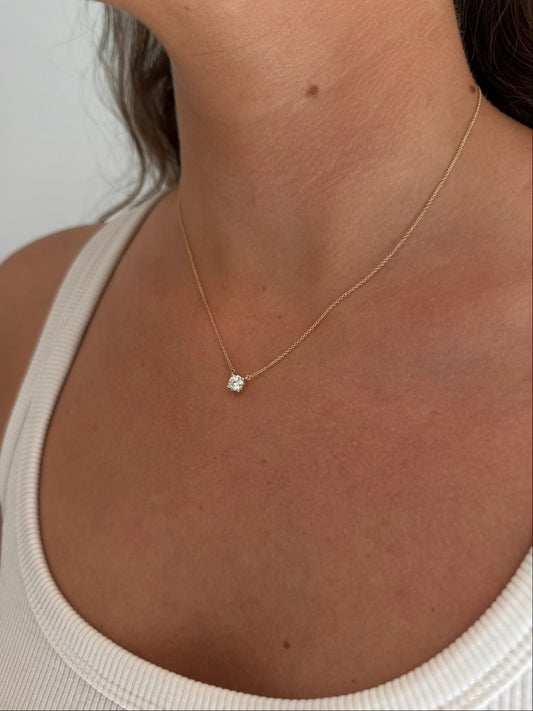


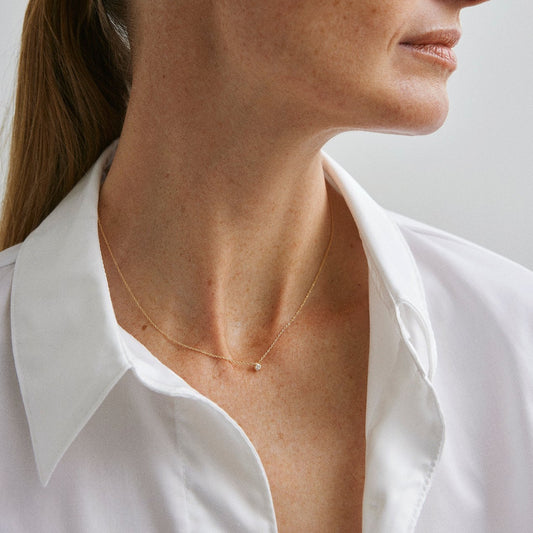

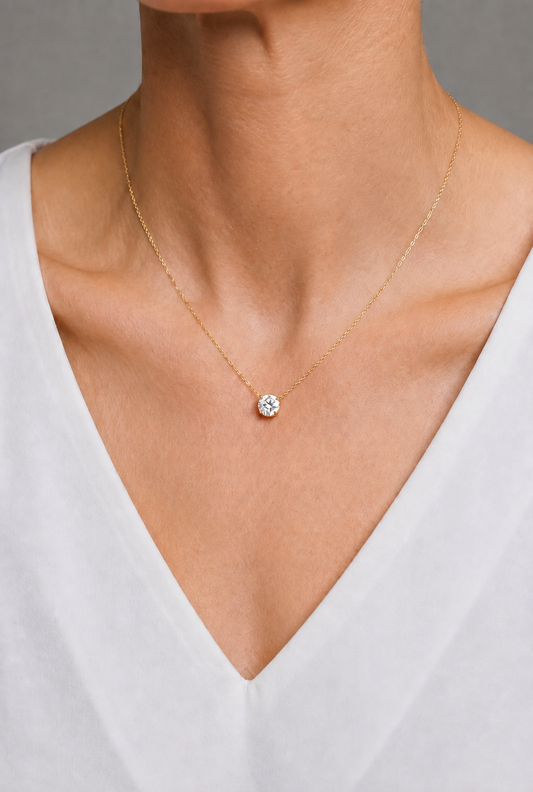

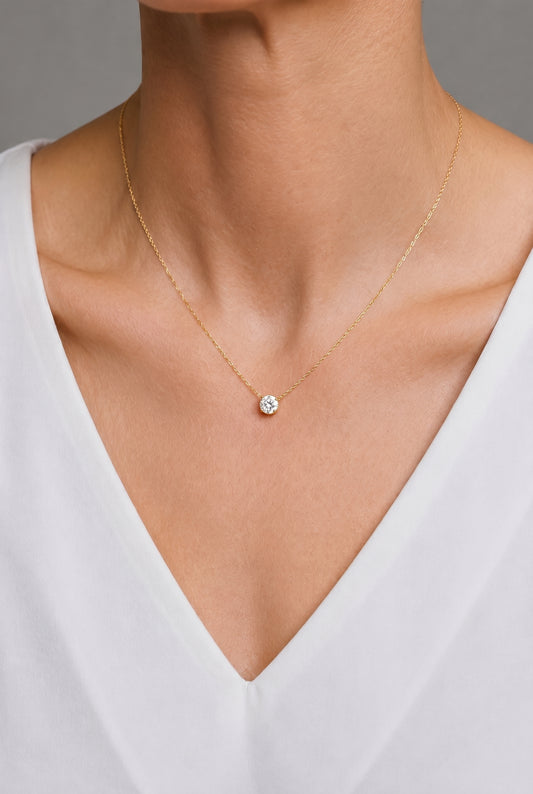

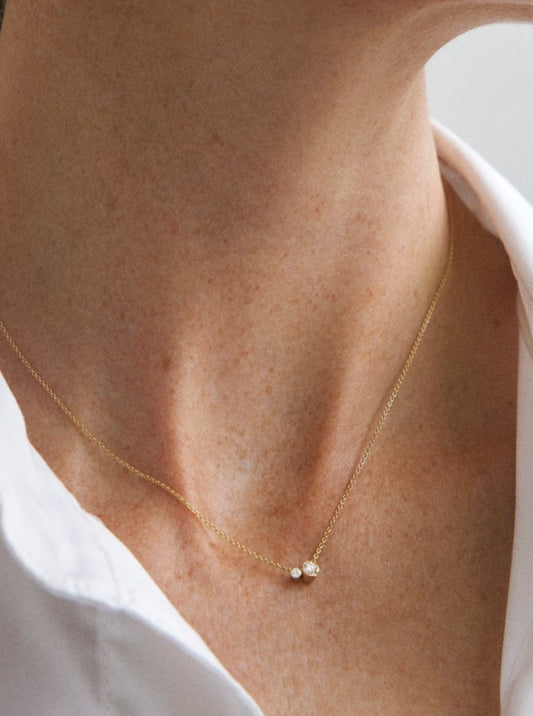
The diamond is the stone in these necklaces
A necklace with a stone at Longvé means a necklace with a diamond. The selection is built around round, brilliant-cut diamonds set in 14K gold or 14K white gold, either as a single stone on the chain or as a row of stones along the neck. You can choose between natural and lab-grown diamonds in the same design, so the choice of stone doesn't tie you to one particular look.
The stone sits either in a prong setting, where small prongs hold the diamond lifted clear of the chain, or in a bezel setting, where a rim of gold goes all the way around the stone. The prong setting lets in more light from the side and makes the diamond appear open and airy. The bezel setting places a smooth gold frame around the stone, sits close to the skin and catches less often on clothes and hair. You'll find the entire selection under diamond necklace, and if you want to see the stone types on their own, they are under lab-grown diamonds and natural diamonds.
A single stone or a row of stones
The first decision is about how much presence the stone should have. A necklace with one stone is the discreet choice for everyday wear. The smallest bezel setting on a tiny bezel carries a 0.03 carat diamond and sits like a small point of light just below the hollow of the throat. If you want more presence, the same setting comes larger, from a medium bezel at 0.10 carat up to a large bezel at 0.17 carat.
If you prefer the prong setting with the same gradation of sizes, it ranges from a tiny prong at 0.03 carat all the way up to a prong necklace at 1 carat, where the single diamond becomes a clear centerpiece in the jewelry.
If you want more than one stone, a bezel diamond necklace places several set stones on the chain, while a tennis design lays a continuous row of diamonds along the neck. Here the range goes from a bezel tennis tiny with a fine line of small stones to a bezel tennis medium at 1.53 carat, which gives a continuous sparkle all the way around. You'll find the complete rows under tennis necklaces.
Gold or white gold around the stone
The metal determines how the diamond reads. 14K gold gives a warm frame, where the warm tone and the clear stone contrast with each other, and the stone is highlighted by the color difference. 14K white gold places a cool, silvery frame that blends in with the diamond's own color, so stone and setting appear as one bright surface.
Most designs come in both metals. A bezel tennis is available both as a bezel tennis necklace in white gold and in the yellow version, and a prong necklace comes both as a prong necklace in white gold and in yellow. If you already wear other jewelry, choose the metal that matches it, so the necklace settles in rather than stands out. Everything in yellow is gathered under gold necklace, and the cool pieces under white gold.
Colored stones versus the clear diamond
Many look for a necklace with a colored stone, a turquoise, a red garnet or another colorful stone as a touch of color. Longvé's selection is built around the clear diamond and does not carry turquoise or garnet as colored semi-precious stones. A few earrings are available with pink sapphire, but on the necklaces the stone is a white diamond.
That doesn't mean color is ruled out. The color a diamond necklace carries comes from the metal. If you choose 14K gold, the chain gets a golden tone that in itself brings warmth to the neck, while white gold keeps the look clean and cool. If you want a distinct shift of color from a colorful stone, a clear diamond in gold is not the answer. But if you want a stone that throws light without being locked to one color, the diamond suits everything in your wardrobe, year-round.
A small stone for everyday and a larger one for celebrations
The occasion often determines the size. For daily wear the small stones win, because they sit close, don't catch and can have other chains alongside them. A tiny bezel or tiny prong at 0.03 carat can stay on in the shower, under a sweater and at night without being in the way. A prong curve necklace lays a light arc of stones below the neck and works as a quiet everyday piece.
For celebrations the stone may have more presence. A prong at 1 or 2 carat or a tennis necklace draws the light to itself during a dinner or at a celebration. If you want a romantic look, a heart-cut necklace gives a heart-cut diamond at 2 carat, which suits a gift for a special day. If the necklace is to be a gift, you can narrow by price under gifts under DKK 2,000 and gifts under DKK 6,000.
A necklace with a letter and a stone
If you want to make the jewelry personal, there is a letter diamond necklace with a letter from A to Z and a small 0.04 carat diamond. It brings an initial and a stone together in one pendant and turns a diamond necklace into a piece that points to a particular person, your own initial or a loved one's.
The letter comes in both 14K gold and 14K white gold, so it can match the rest of your jewelry. As a gift it lands somewhere between the personal and the classic, because the stone keeps the look in line with the rest of the diamond necklaces. The entire range of letters is under letters.
How to keep the stone clear and the chain intact
A diamond is the hardest material there is, sitting at 10 on the Mohs scale, so the stone itself won't scratch in daily wear. What takes the shine away is skin oil, soap and cream that settle like a film on the stone and dim the light. A film is removed with lukewarm water, a drop of mild soap and a soft brush, after which the chain is rinsed and patted dry.
The bezel setting is the most robust for everyday wear, because the gold rim covers the edge of the stone all the way around. The prong setting lets in more light, but over time the prongs can catch on knitwear, so it can benefit from a check now and then. Store the chain separately so it isn't scratched by other jewelry, and avoid sleeping with the finest chains on, so the clasp and links aren't pulled out of shape. More about cleaning is in how to clean jewelry
The length that suits the neckline
The length determines where on the chest the stone lands. A shorter chain places the pendant high up at the hollow of the throat, where it shows over a shirt collar or a thin knit. A longer chain lowers the stone down onto the chest, where it gets more room and can be worn over a blouse.
The short lengths are easiest to combine with other chains in layers, because they sit offset and don't collapse together. If you want to wear several at once, choose different lengths so each stone gets its own line. If you're unsure what suits you, how long should a necklace be goes through the common measurements and how they fall.