















How to find the right diamond earrings
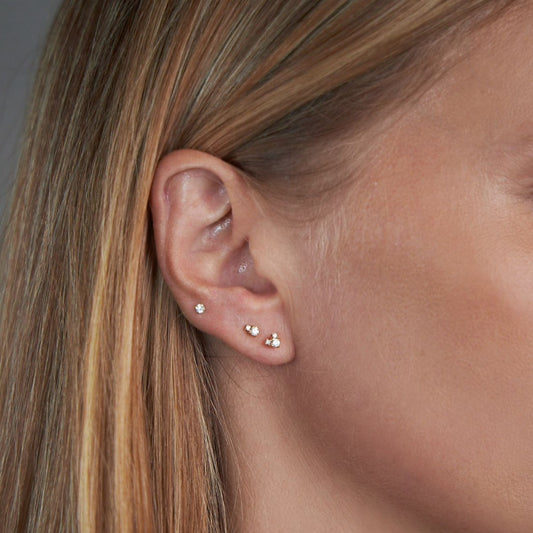
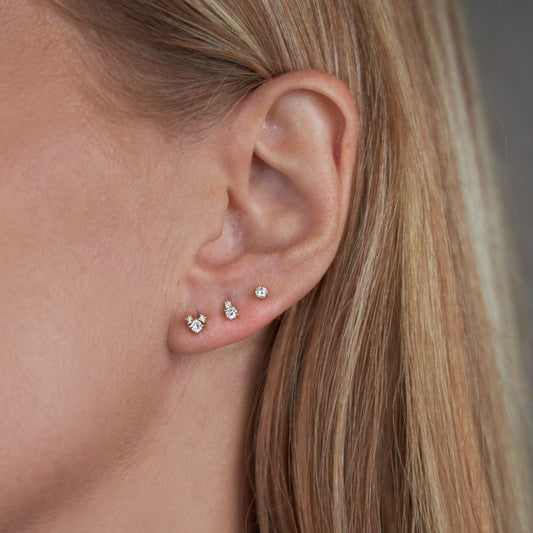
In practice, diamond earrings fall into two main types, and the choice between them determines both the look and the price. Studs sit close to the earlobe with a single diamond, while huggies are small hoops that hug the earlobe and can either carry diamonds or stand as a smooth ring. This collection features both, cast in 14 karat gold, and the diamond weight ranges from 0.01 carat in the smallest Tiny Diamond Huggies up to 0.57 carat in the longest Long Dangling Diamond Bezel Stud. The practical question for most people is therefore: how large a diamond do you want visible in your ear, and should the setting be a classic prong or an enclosed edge. The rest of the text goes through exactly these choices.
Prong or bezel: what the two settings mean
The two types of setting you encounter again and again in the collection are called prong and bezel, and the difference is worth understanding before you choose. A prong setting holds the diamond with small claws that grip the stone from the side. Because the metal takes up as little space as possible, more light enters from the edges, and the stone appears a touch larger and more open. A bezel setting, by contrast, surrounds the diamond with a continuous metal edge all the way around. The edge protects the stone's rim from knocks and makes the stud smooth to insert and remove, which many people appreciate in everyday life. In return, the edge covers a small part of the stone. In the collection you'll find the same diamond weights in both settings, for example the Small Prong Diamond Stud and the Small Bezel Diamond Stud, each with 0.06 carat, so you can choose the look independently of the size.
What carat means, and how large the diamond will look in the ear
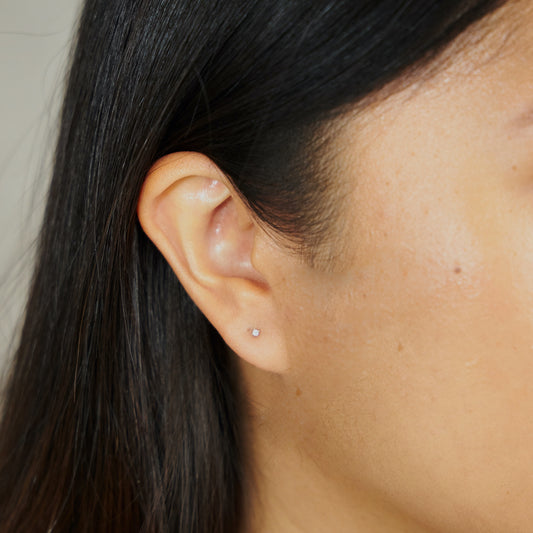
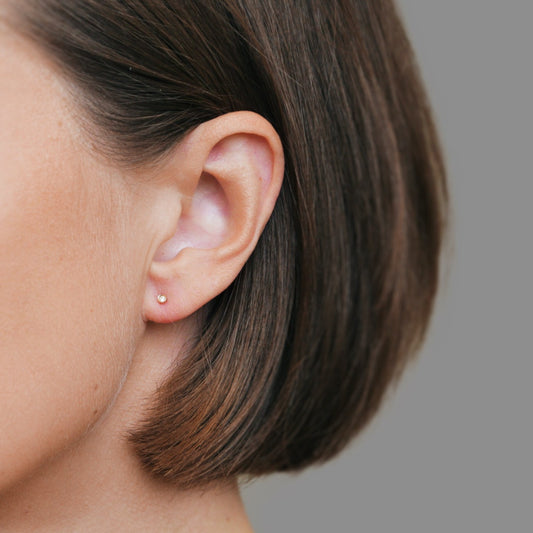
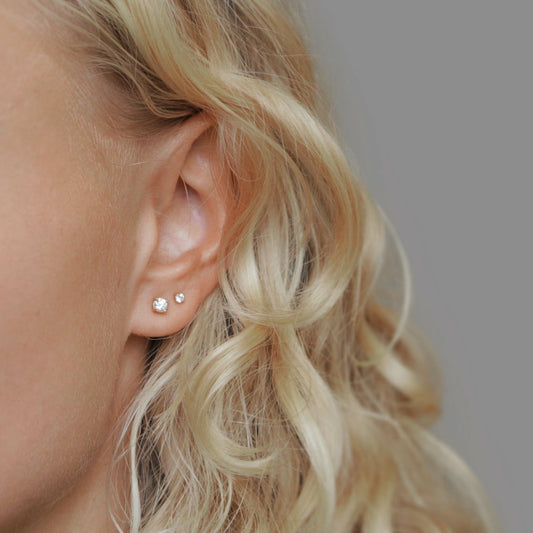
Carat is the weight of the diamond, not directly its width, but the two naturally go hand in hand. In studs, the collection starts at the Tiny Prong Diamond Stud at 0.015 carat, which is a discreet dot of light that suits an extra piercing or someone who wants a diamond without it being noticed from a distance. Step up to the Medium Prong Diamond Stud at 0.17 carat, and the stone becomes clearly visible and works as a pair you can wear every day and still notice. Because the weight doubles quickly as the sizes increase, the price rises more than proportionally: a diamond of twice the carat number typically costs more than twice as much, because larger stones are rarer. It is therefore worth deciding how visible you want the stone before looking at the price.
The four C's briefly explained
A diamond's quality is described by four measures known in English as the four C's: carat, cut, color and clarity. Carat is the weight, as covered above. Cut concerns how precisely the stone's facets are shaped, and it is the cut that determines how much light the diamond reflects back. A well-executed cut makes even a small stone sparkle. Color indicates how colorless the stone is, with the most sought-after diamonds being completely free of a yellowish tone. Clarity describes how few inclusions the stone has inside. In a pair of earrings, cut matters most for the visible sparkle, while in practice you won't see small differences in color and clarity with the naked eye from the distance of an ear.
Gold or white gold: karat with a k and carat with a c
Two words that sound alike mean two different things, and it is useful to keep them apart. Karat with a k indicates the purity of the gold, and all earrings in this collection are cast in 14 karat gold, which means an alloy with a gold content that is hard enough for daily use. Carat with a c is the weight of the diamond. This collection is in gold, but if you would rather have a cool, silvery-white frame around the diamond, similar jewellery is available in white gold. The choice between yellow and white gold is purely aesthetic: gold gives the diamond a warm framing, while white gold lets the stone stand out more neutrally.
Huggies with diamonds for everyday wear
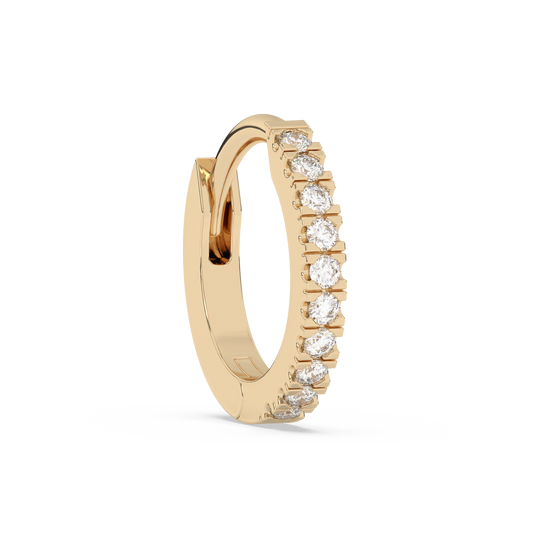
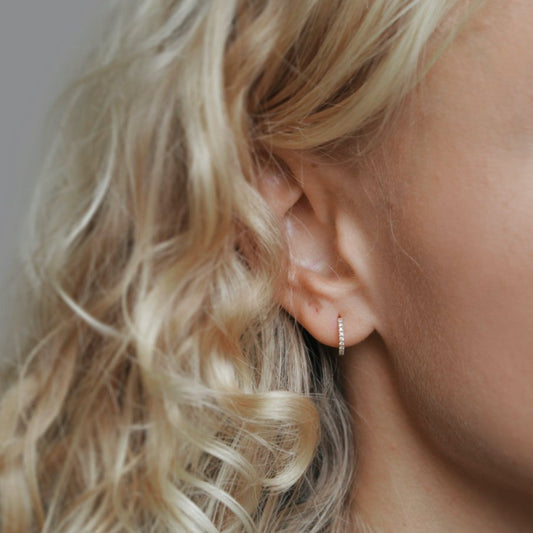
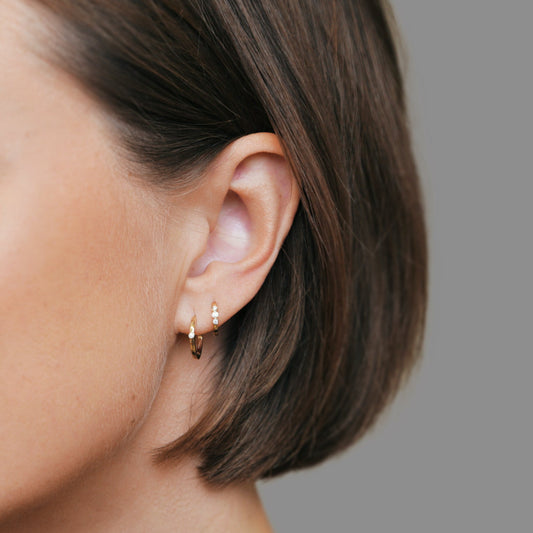
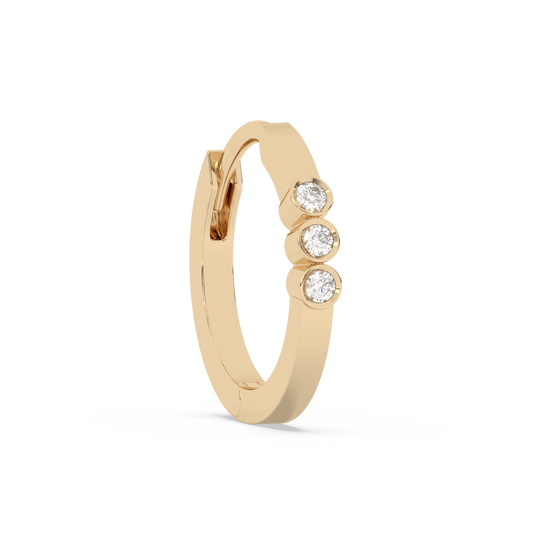
Huggies have become one of the most popular alternatives to the classic stud, because they sit close and rarely get caught. In the collection they range from Tiny Diamond Huggies with 0.01 carat up to Medium Diamond Huggies with 0.09 carat, where the diamonds sit along the front edge of the hoop. If you want more light all the way around, there are Small Double Diamond Huggies with two rows of stones. Because huggies take up a little more space than a stud, they are well suited as the pair you leave in day in and day out. Note that several products in the collection are sold as a single, that is, one earring, which makes it possible to build an asymmetrical set or wear several piercings with different sizes.
Dangling studs for when the diamond should move
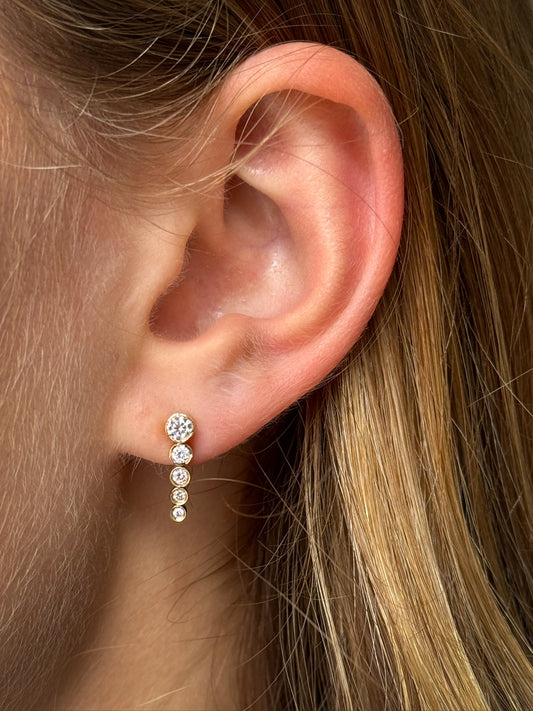
Not all diamond earrings sit completely close. The collection's dangling models let a bezel-set diamond hang a little below the earlobe, so the stone moves and catches light when you move your head. The Short Dangling Diamond Bezel Stud carries 0.41 carat, while the Long Dangling Diamond Bezel Stud with 0.57 carat hangs lower and features the largest single diamonds in this collection. The bezel setting around the stone means the edge is protected, even though the piece moves freely. This type works as a bolder choice for an occasion, whereas a pair of close-fitting studs is the discreet everyday option.
How long should new earrings stay in before you can change them
If you buy diamond earrings for a freshly pierced hole, the same precautions apply as for all first earrings. A new piercing needs peace to heal, and you should leave the first earrings in until the hole has settled, typically several weeks, before changing to another pair. If you change too early, the hole may close or become irritated. Diamond earrings are therefore rarely the very first pair in a completely fresh piercing, but they are an obvious choice once the hole has healed and is ready for something lasting. If you want to read more about how to keep the earrings clean along the way, there is a thorough walkthrough in the article on How To Clean Earrings.
How to clean diamond earrings at home
Diamonds attract grease from skin, hair and cream, and a thin film on the stone dulls precisely the sparkle you paid for. Fortunately, cleaning is straightforward. Lukewarm water with a drop of mild dish soap and a soft toothbrush loosens most of the dirt around the setting, after which you rinse and pat dry with a lint-free cloth. With bezel settings, dirt easily gathers along the metal edge, while prong settings have open gaps where the brush reaches easily. The gold itself can be polished using the same method. A more detailed guide for both stone and metal can be found in the guide on How To Clean Jewellery.
Diamond earrings as a gift
A pair of diamond earrings is a classic gift choice for a birthday, a graduation or a milestone anniversary, partly because they suit almost anything and don't require you to know the recipient's size in advance, the way a ring does. If the gift should be discreet and for daily use, a pair of small studs or Small Diamond Huggies is a broad fit. If it should be bolder, the larger studs and the dangling models point upward. If you want to see the entire earring range in one place before deciding, it is gathered under earrings, and the rest of the jewellery selection under Shop All Jewellery.