







Small earrings for everyday wear
Small earrings are the ones that stay in place when the rest of the jewellery goes into the dish for the night. They are light enough to forget you are wearing them, and discreet enough to suit both a weekday at the office and a Friday night out. At Longvé, the small models cover three basic types: studs, huggies and double huggies, all in 14K gold or 14K white gold, and several with diamonds. Here is a run-through of the differences between the types, how small they actually are, how the diamond weight changes the look, and what you should know about wearing them all the time.
Studs, huggies or double huggies
The three types of small earrings sit differently and give different looks.
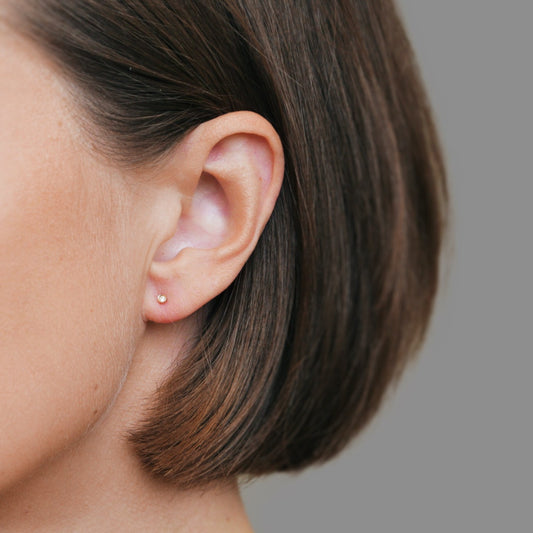
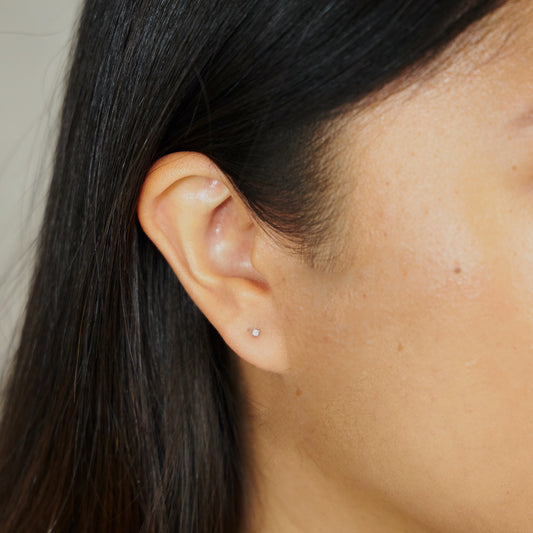
A stud is a straight post that goes through the earlobe and is held by a fastening at the back. The piece itself sits flat against the lobe and points forward. It is the most discreet type and the classic everyday earring. See the selection under stud earrings.
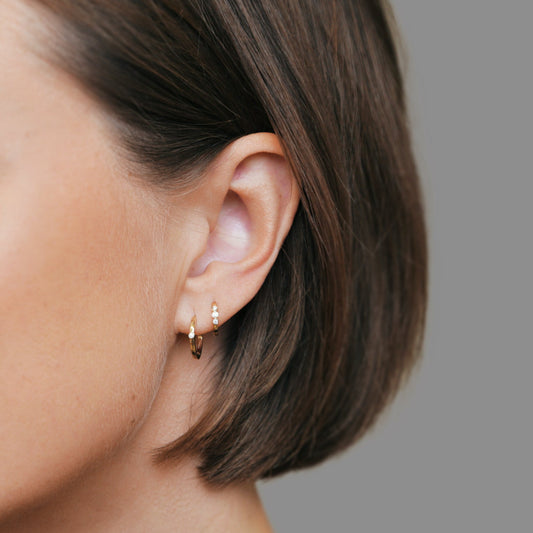
Huggies are small hoops that sit closely around the earlobe, almost as if they are hugging it. They form a small ring instead of a point, and they move slightly when you move your head. The whole selection is found under huggies.
Double huggies consist of two small rings sitting together, so you get more volume without the earring becoming large. It gives a slightly more striking look, but still in the small format. They are gathered under double huggies.
The difference between tiny and small
Longvé's small earrings come in two sizes, tiny and small, and the difference is worth knowing before you choose.
Tiny is the smallest. A tiny huggies is a very small ring that sits right up against the lobe and almost disappears in profile. Small is slightly larger and more visible, without turning into an actual hoop. A small huggies takes up a little more space and gives a more distinct ring around the lobe.
The same logic applies to diamond studs. A tiny prong diamond stud has a diamond of 0.015 carat, whereas a small prong diamond stud has a diamond of 0.06 carat. Both are small, but one is an almost imperceptible glint, the other a distinct little sparkle. If you want the most understated look, tiny is the choice. If you want a little more presence, small is the way.
Prong or bezel on the studs
On the small diamond studs, the setting determines how the diamond looks and sits.
A prong setting holds the diamond with small claws, so the stone is lifted up and takes in light from the sides. This gives the most sparkle and a classic look. A small prong diamond stud shows the principle clearly.
A bezel setting surrounds the diamond with a rim of metal all the way around. The stone sits lower and more protected, and the rim gives a round, calm look. A small bezel diamond stud does not catch as much light as the prong version, but it has no claws that can catch on clothes or hair. For exactly this reason, bezel is often a good choice for earrings you wear all the time. Both types are gathered under prong stud and bezel stud.
Fancy cuts in the small format
The studs don't have to be round. The small fancy cuts give a different look, without the earring becoming large. A small pear cut diamond stud has a pear-shaped diamond of 0.10 carat that points gently downward and gives a little direction to the face. A small emerald cut diamond stud has a rectangular emerald-cut diamond with calm, step-like facets and a more understated, clear glint than the round cut. Both cuts come in both 14K gold and 14K white gold and with both natural and lab-grown diamonds. Several of them are gathered under fancy cut studs.
Natural and lab-grown diamonds in the same design
Several of the small diamond earrings come with both natural and lab-grown diamonds in exactly the same design. A lab-grown diamond has the same chemical composition and the same optical properties as a natural diamond and is just as hard, a ten on the Mohs scale. The only difference is where the stone was formed. This means you can choose a pair of small emerald cut lab-grown diamond stud and get the same look as the corresponding pair with a natural diamond. If you want to see the whole selection of this kind, the earrings are gathered under lab-grown diamond earrings.
14K gold or 14K white gold
Almost all of the small earrings come in both 14K gold and 14K white gold, and the choice is mostly about what else you wear. 14K gold has a warm, golden tone that suits warm skin tones and goes with other gold jewellery. 14K white gold has a cool, silvery-white tone that highlights a diamond's white light and fits with silver jewellery and steel watches. If you wear several pieces of jewellery at once, it is easiest to keep the metal consistent. The two collections are gathered under gold and white gold.
Can you wear small earrings all the time?
Small earrings are exactly the type suited to staying in day and night. They are light, they have no large parts that catch, and a bezel setting without claws makes the risk of snagging them even smaller. 14K gold and 14K white gold also tolerate good contact with skin, so they are suited to daily wear.
Sleeping with earrings in is possible with small models, but a few things are worth knowing. Studs with a fastening at the back can press against the pillow, and huggies should sit completely close so they do not twist during the night. Water and soap do not harm gold, but over time soap residue can settle as a film that dulls a diamond's shine. If you take them off before bathing and dry them afterward, they stay bright for longer. How to clean them is described in the article on how to clean earrings.
Buy singly or as a pair
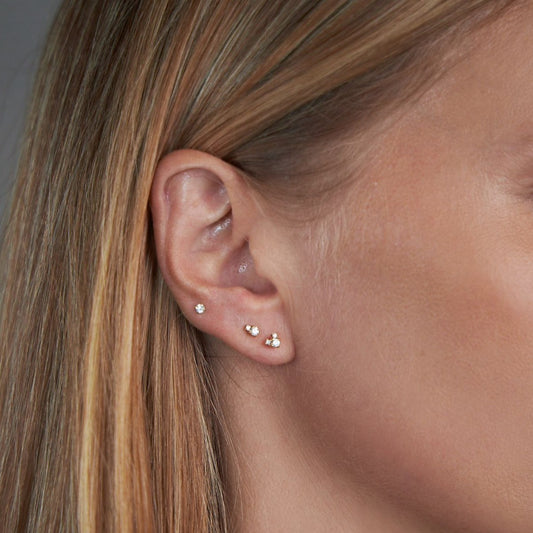
The small earrings are sold both as a pair and as a single piece. A single piece is practical in several ways. If you have several piercings in the same ear, you can mix sizes and types, for example a small stud at the bottom and a huggies at the top. If you lose one of a pair, you can replace just that one without buying a whole new set. And if you want to build an asymmetric look over time, you can do it one piece at a time. If you are looking to match several earrings, there are pairs and single pieces that go together gathered under matching jewellery.