What are lab-grown diamonds?
-

-
Lab-grown diamonds are real diamonds. They consist of pure, crystallised carbon in the same atomic structure as diamonds formed in the earth, and they have the same physical, chemical and optical properties. The difference lies solely in where they came into being: in a laboratory under controlled conditions instead of deep within the earth's crust.
This means that a lab-grown diamond measures 10 on the Mohs scale, refracts light in the same way and is assessed according to the same criteria as natural diamonds. It is not an imitation or a copy - it is a diamond.
How are lab-grown diamonds created?
All diamond formation requires carbon, high temperature and either enormous pressure or a special chemical process. In nature it takes a very long time. In the laboratory the same conditions can be created in weeks.
The process almost always begins with a diamond seed - a thin slice of an existing diamond, from which the new crystal grows further. From here two main methods are used.
HPHT - High Pressure High Temperature
The HPHT method mimics the conditions found deep in the earth. The diamond seed is placed together with pure carbon in a press, where the material is exposed to temperatures of around 1,300-1,600 degrees and pressures of several gigapascals. The carbon melts and crystallises around the seed, layer upon layer, until a rough diamond has formed.
HPHT is the older of the two methods and is also used to treat diamonds to affect their colour.
CVD - Chemical Vapor Deposition
The CVD method works with significantly lower pressure. The diamond seed is placed in a vacuum chamber, which is filled with a carbon-rich gas - typically methane mixed with hydrogen. The gas is heated until the molecules split, and the free carbon atoms settle on the seed in thin layers.
CVD gives great control over the process and is used today for a very large proportion of the lab-grown diamonds that end up in jewellery. After growth, the rough stone is cut in the same way as a natural diamond - by a diamond cutter, with the same angles, proportions and finish requirements.
Can you tell the difference between lab-grown and natural diamonds?
No - not with the naked eye. Two brilliant-cut stones of the same colour, clarity and carat look identical, regardless of whether one grew in the earth and the other in a laboratory. Both have the same refractive index, the same hardness and the same play of light.
The difference can be detected with specialised equipment in a gemmological laboratory, where growth patterns and trace elements in the crystal are analysed. This is the kind of analysis behind the certification of the stones - not something that can be read in a shop or under an ordinary loupe.
Lab-grown diamonds are also often marked with a microscopic engraving on the girdle, which identifies the stone and its certificate. The engraving is not visible when the jewellery is worn.
How is a lab-grown diamond assessed?
Lab-grown diamonds are graded according to the same four parameters as natural diamonds - the four Cs. Together they determine how the stone looks and how much light it throws.
Cut
The cut has the greatest influence on how a diamond is perceived. Angles, proportions, symmetry and polish determine how effectively light is reflected back through the top surface of the stone. A stone with good proportions appears lively; a stone that is too deep or too flat loses light out through the sides, no matter how clear it otherwise is.
Color
The colour scale ranges from completely colourless towards faint yellowish shades. On the Danish scale grades such as River, Top Wesselton and Wesselton are used, where the top grades are the most colourless. In white gold a very white stone is emphasised, while gold naturally casts a warm tone into the stone - something many deliberately play on in their choice of metal.
Clarity
Clarity is about how many and how visible the inclusions in the stone are. The grades range from flawless to clearly visible inclusions, and in practice most people choose a grade where the inclusions cannot be seen with the naked eye. Both lab-grown and natural diamonds form with small irregularities - it is part of the crystal growth.
Carat
Carat is a unit of weight, where 1 carat equals 0.2 grams. The weight says something about the size of the stone, but not everything: two stones of the same carat can look different in diameter, depending on how they are cut. With round brilliants, however, the relationship between carat and diameter is fairly predictable, and that is why many people orient themselves by carat when comparing designs.
Which jewellery is made with lab-grown diamonds?
Lab-grown diamonds are used in exactly the same designs as natural diamonds - from small stud earrings to engagement rings with a striking centre stone.
Rings with a centre stone
The solitaire design with a single stone is the most classic. Here the expression is carried by the shape of the stone and by the setting, and the most commonly used shapes are round brilliant, oval, pear, cushion, emerald and marquise. The shape changes the character markedly: an oval or marquise-cut stone appears more elongated, while the cushion shape gives a softer, square expression.
If you want more volume, there is the trilogy design with a centre stone flanked by two side stones, such as an oval trilogy ring. Alternatively, the ring band can be set with small diamonds all the way up towards the stone - as on a round pavé ring, where the pavé details give extra light around the centre.
Alliance and eternity rings
An eternity ring has diamonds all the way around the band, while a half eternity ring has diamonds halfway around. Both come in several widths, where the stone size follows the thickness of the ring - from very discreet rows to wider designs with distinct light. A small eternity ring is an example of the light variant, while a large half eternity ring has stronger stones on the upper half.
Necklaces and pendants
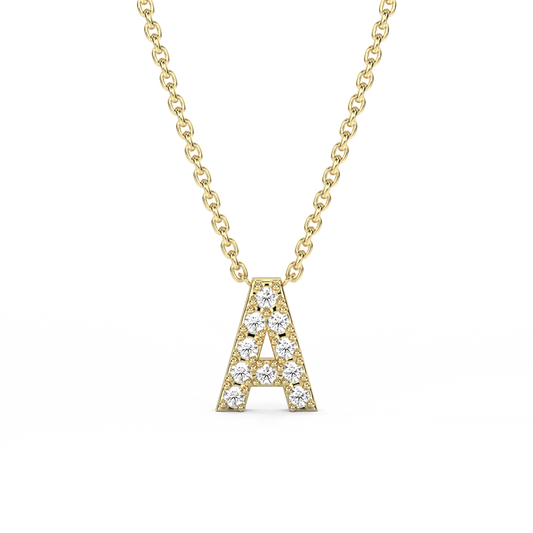
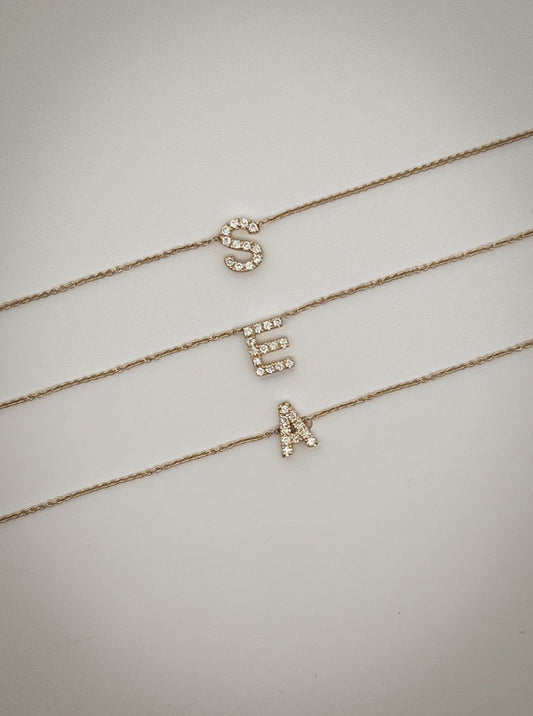
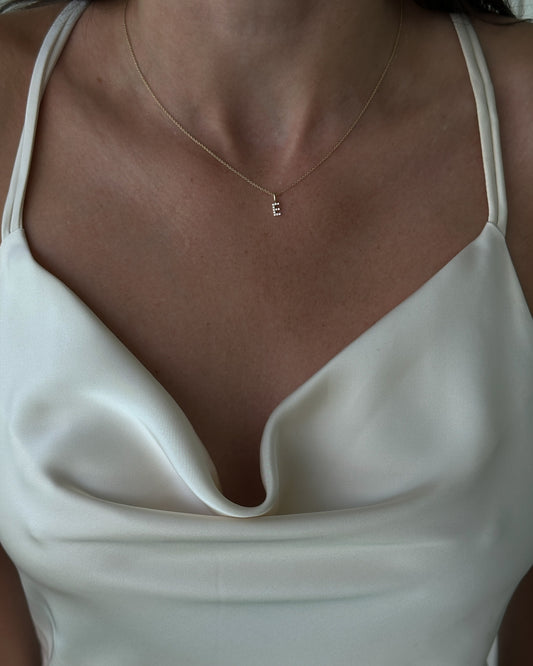
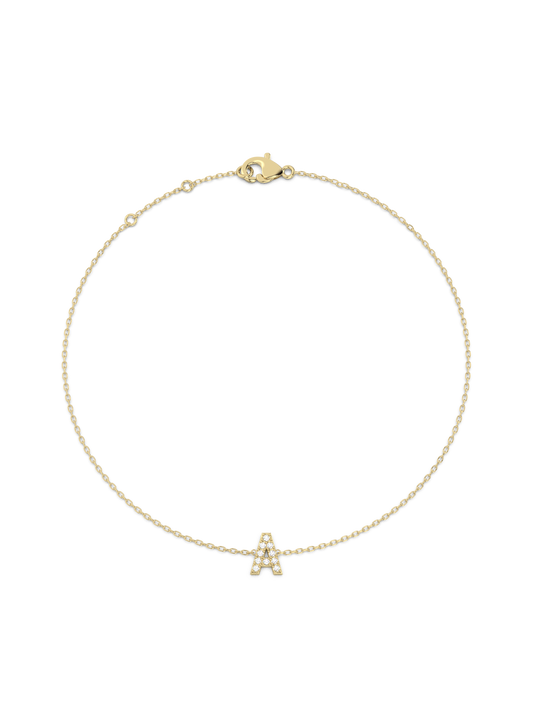
For necklaces, lab-grown diamonds are used both as single stones and in rows. A solitaire pendant with a single stone is the most versatile solution, because it can be worn alone or together with other chains - for example a solitaire pendant, where the chain is chosen separately.
If you want the stone permanently mounted on the chain, there are finished designs such as a prong necklace with the stone in a prong setting, or a heart cut necklace with a heart-shaped stone as the centrepiece.
Stud earrings
Diamond stud earrings are among the most commonly worn diamond jewellery, precisely because they work in all settings. They come from very small stones to larger, distinct studs, and they are sold both individually and in pairs - for example a pair of prong studs, where the stone is held by fine prongs so that as much light as possible enters from the side.
Which metal suits a lab-grown diamond?
The choice of metal affects how the stone is perceived. White gold has a cool, neutral tone that makes a very white diamond appear even whiter, and which gives a discreet, uniform expression where the stone stands alone in focus.
Gold has a warm tone that is slightly reflected in the stone and creates a softer interplay between setting and diamond. It is often the choice that feels most classic, and it suits both the very colourless grades and the slightly warmer stones.
Many people also combine metals across several rings or chains, and there are no fixed rules for how it is done.
How do you care for a lab-grown diamond?
The stone itself is extremely hard and withstands daily wear, but the setting and the metal around it require a little attention. Diamonds attract grease and soap, and a thin film on the underside of the stone noticeably dampens the passage of light. A soft toothbrush, lukewarm water and a little mild soap are enough to restore the shine.
Rings should be taken off during hard physical work, training and cleaning with strong agents, where the metal can get knocked or scratched. Jewellery with several small stones - pavé, eternity, half eternity - should over time be checked for loose settings, because the prongs and edges wear over the years.
Store diamond jewellery separately from one another. A diamond can scratch all other materials, including other diamonds, and soft pouches or separate compartments prevent damage.
What should you decide before choosing?
The choices that have the greatest influence on the final result concern the shape of the stone, its size in relation to the hand, the type of setting and the tone of the metal. The shape sets the keynote: round brilliant is the most brilliant and classic starting point, while oval, pear and marquise-cut stones give a more elongated expression, and cushion and emerald a calmer, more geometric one.
The setting determines how exposed the stone is and how much light enters. A prong setting lifts the stone free and lets the light come from the sides, while a bezel setting encloses the girdle and gives a lower, more robust profile.
If the ring is to be worn together with a wedding ring, it is worth considering the profile from the side, so that the two rings lie flat against each other. It is becoming increasingly common to choose two rings - one engagement ring and one wedding ring - and they need not be the same in metal or design to work together.