What are stud earrings?
-

-
Stud earrings are earrings with a straight metal post that is passed through the hole in the earlobe and held in place with a fastening on the back. The jewellery itself sits close against the earlobe and does not move freely, and that is precisely what sets stud earrings apart from ring-shaped earrings such as hoops. The design is the most widespread of all earring types, because it is simple to put on and take off and can be worn every day without getting in the way.
The word refers to a fixed construction rather than a particular appearance. A stud earring consists of three parts: the visible front, a post at the back and a fastening that grips the post and holds the earring in place. The front can be anything from a single small ball to a set diamond, and this is where by far the most variations lie.
For exactly this reason, stud earrings can look very different, even though the mechanism is the same.
How a stud earring sits in the ear
The post is pushed through the hole from the front, so the front faces outward, and the fastening is pushed on from behind. The most common fastening is a small metal butterfly back with a hole in the middle, which clamps onto the post by friction. It sits tightly enough to stay in place during daily use, but can be pulled off again with your fingers when the earring needs to be removed.
Because the whole piece lies flat against the earlobe, a stud earring does not hang and dangle the way a drop earring does. This makes them practical for sleeping, sport and work, where larger earrings can easily get caught or become a nuisance. In many cases, a small stud earring can stay in place day and night without getting in the way.
What is the difference between stud earrings and hoops?
The difference lies in the shape and in how the earring is held in place. A stud earring has a straight post and a flat front that lies against the earlobe, while a hoop is ring-shaped and closes on itself through the ear. Hoops therefore form a visible circle extending out from the ear, whereas the stud earring stays discreetly close to the skin.
The two types are often worn for different occasions. The stud earring is the quiet, everyday choice, while the hoop provides more movement and takes up more visual space. If you want to combine both looks, there are small, close-fitting hoops in the form of huggies, which hug the earlobe in a way that is closer to the stud earring's discreet style than a large hoop is. A wider selection of both kinds can be found under earrings.
Settings determine how the stone sits
When a stud earring has a diamond or other stone, it is the setting that determines how the stone is held in place, and how much light reaches it. Two settings recur on classic diamond stud earrings, and they each give their own look.
Prong setting with claws
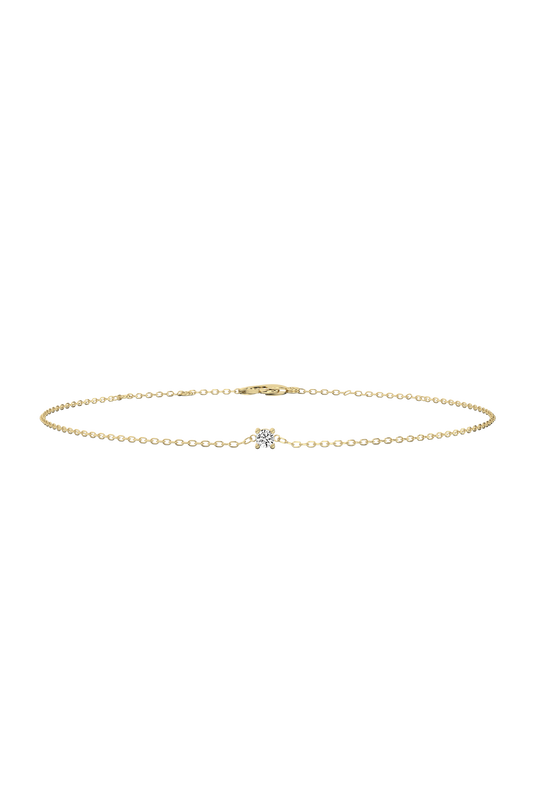
A prong setting holds the stone with small metal claws that grip the edge and lift it slightly up from the earlobe. Because the claws cover only a small part of the stone, light comes in from several sides, and the diamond stands free and visible. This open setting is the one many associate with the classic diamond stud earring, and it is available in everything from very small stones to larger ones. One example is a pair of prong stud in 14K gold.
Bezel setting with a metal rim
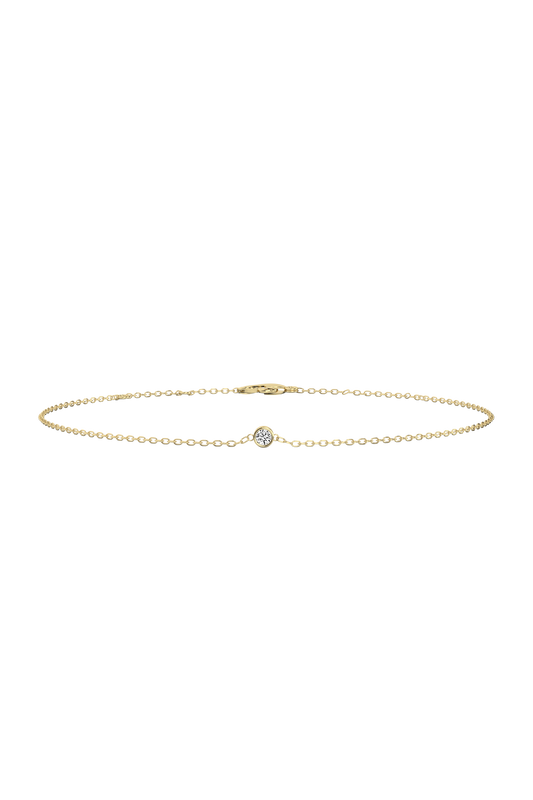
A bezel setting encloses the stone with a smooth metal rim all the way around. The rim protects the stone's sides and gives a calm, rounded look, where the diamond sits flatter against the earlobe than in a prong setting. Because there are no claws that can catch on clothing or hair, the bezel setting is a robust choice for daily use. See for example a pair of bezel stud in 14K gold.
Cuts and shapes on diamond stud earrings
In addition to the setting, the stone itself can be cut in several ways, and the shape changes the character of the earring significantly. The round brilliant-cut diamond is the most widespread, because it reflects a lot of light, but several other shapes are used for stud earrings.
A pear-shaped stone is teardrop-shaped with a point at one end and a soft curve at the other. An emerald-cut diamond has a rectangular shape with step-like facets that give a more subdued, mirror-clear look than the round cut. Both are available at Longvé, including as a pair of pear cut stud and a pair of emerald cut stud.
At Longvé, diamond stud earrings are available both with lab-grown diamonds and with natural diamonds, often in the same design, so the same stud earring can be chosen in either variant. A lab-grown diamond is a real diamond with the same physical and optical properties as a natural diamond - the difference lies solely in where it was formed. A combined selection can be found under diamond earrings.
Sizes and materials
Stud earrings come in many sizes, from very small stones that almost disappear against the earlobe, to larger ones that take up more space. A small stone is easy to wear every day and is barely noticed, while a larger diamond provides a more distinct eye-catcher. Because the stud earring sits flat, even a larger stone rarely feels heavy or impractical.
The base metals at Longvé are 14K gold and 14K white gold. Gold gives a warm tone, while white gold is cool and bright and is often chosen because it makes a diamond appear especially clear. A few stud earrings are also available with a pink sapphire instead of a diamond. Simple gold studs without a stone can be seen under stud 14K gold, and white gold variants can be found under white gold.
Why are stud earrings sometimes sold individually?
Some stud earrings are sold as a single earring and not as a pair. This makes sense for anyone who wants to wear two different earrings, or who has several holes in the same ear and wants to combine them as they wish. If you want a matching pair, you buy two singles of the same model, or you choose a variant that is already sold in pairs.
Selling them individually also makes it easy to replace a single earring if one of them goes missing, without having to buy a whole new pair.
How to keep stud earrings clean
Over time, stud earrings collect skin oil, soap residue and small particles behind the stone and around the fastening, and this can make them look dull. Gentle, regular cleaning keeps them clear. Lukewarm water with a little mild soap and a soft brush, for example an old toothbrush, removes most dirt, after which the earring is rinsed and dried carefully with a soft cloth.
The claws on a prong setting should be checked from time to time, as they can bend slightly with daily use. A bezel setting requires less of that kind of attention, because the metal rim protects the stone. A more detailed walkthrough can be found in the guide on how to clean earrings.