

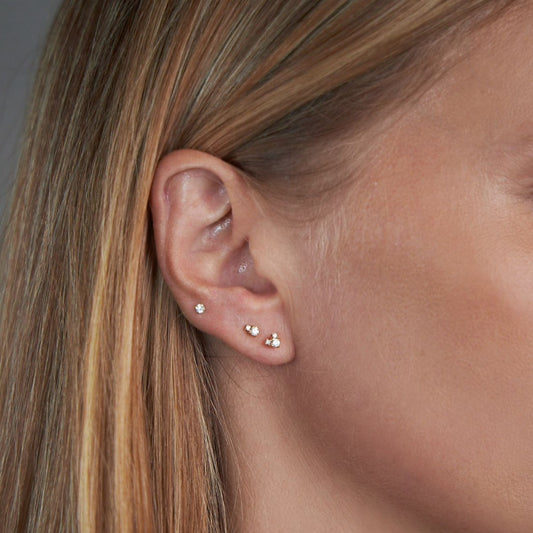

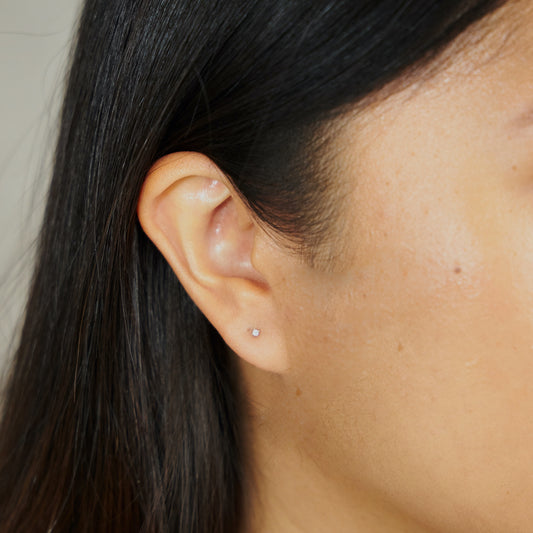

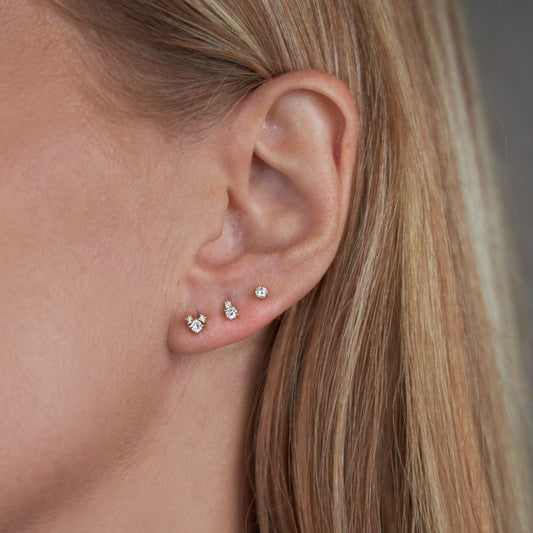

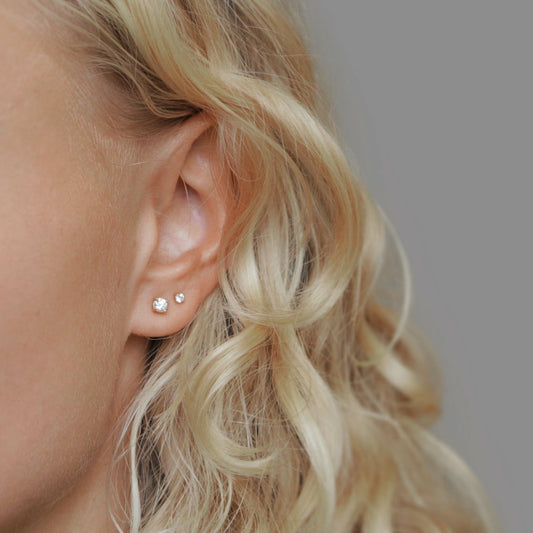
Stud earrings in 14 karat gold and white gold with diamond
A stud is the classic earring that sits close against the earlobe with a straight post through the hole and a closure mechanism at the back. Here all stud earrings are made in solid 14 karat gold, either gold or white gold, and the vast majority have a diamond as the centre stone. That makes them the kind of jewellery you can wear all the time: in the shower, at training and at night. Because they lie flat against the ear and do not hang freely, they have no hook or loop that can catch on clothing or hair.
The selection ranges from a diamond of 0.015 carat, which only just makes its mark, to solitaire studs of 1.0 carat per ear. You choose the metal, cut, setting and size yourself, and whether you want a single stud or a whole pair. Below we go through those choices so you can find the ones that suit you.
Bezel or prong as setting
The biggest difference between the studs here is how the diamond is held in place. A prong stud holds the stone with small claws that grip around the edge and lift it slightly clear of the metal. This lets light enter from several sides, so the diamond sparkles more, and it is the classic way to set a solitaire stone.
A bezel stud instead has a continuous metal rim that encloses the stone all the way around. The rim makes the diamond a touch more understated, but in return it is well protected: there are no claws that can catch on a jumper or a scarf. That makes the bezel setting an obvious choice for studs that stay in the ear around the clock. If you want to see the two types side by side in jewellery other than studs, you can compare prong jewellery and bezel jewellery.
Size and carat from 0.015 to 1.0 carat
The weight of the diamond is measured in carats, and here it goes from 0.015 carat in the smallest up to 1.0 carat per ear in the largest solitaire studs. The four fixed steps are called tiny, small, medium and a larger prong or bezel stud, and each size comes in both gold and white gold.
The smallest, tiny prong diamond stud and tiny bezel diamond stud at 0.015 carat, are almost discreet and work well as the earrings that are never taken out, or as the extra stone higher up in the ear. If you want a little more, small prong diamond stud and small bezel diamond stud at 0.06 carat give a clear glint without becoming dominant. Medium Prong Diamond Stud and medium bezel diamond stud at 0.17 carat are the classic middle step that most people go for. If you are looking for large stud earrings, it is the solitaire versions of 0.5 and 1.0 carat that make the biggest statement in the ear.
Round, pear and emerald cut
The vast majority of studs have a round brilliant cut, which is the cut that sparkles the most and suits almost everything. If you want something other than the round, there are also fancy cuts. The pear cut is teardrop-shaped with a pointed end and a rounded bottom, and you will find it in small pear cut studs and medium pear cut studs. The emerald cut is rectangular with cut corners and step-shaped facets that give a calmer, more mirror-like light rather than many small glints; it is seen in small emerald cut studs and medium emerald cut studs. The entire selection of the angular and shaped cuts is gathered under fancy cut studs.
Gold or white gold
All studs are available in 14 karat gold and in 14 karat white gold, so the choice is about what suits you and the rest of your jewellery. Gold has the warm tone that most people associate with gold, while white gold is a gold alloy with a cool, silvery sheen that is often rhodium plated to become even whiter. If you already wear silver-coloured jewellery or white metal, the white gold studs fit in naturally, while gold gives a warmer contrast against the skin. You can see the entire range gathered under gold and white gold if you want to build a set that matches. If you want to know more about what white gold actually is and why it is white, we have a rundown of what is white gold.
Natural or lab-grown diamond
Several of the studs are available with both natural diamond and lab-grown diamond. A lab-grown diamond is grown in a laboratory under the same pressure and heat that create a natural diamond in the earth. It has exactly the same chemical and physical properties and looks identical to the naked eye; the difference is the origin and typically the price, where a lab-grown diamond often gives more carats for the money. This is most clearly noticeable in the large solitaire studs, where a Prong Lab-grown Diamond Stud - 14K Yellow Gold (1.0 ct.) | Pair gives a markedly bigger glint for the budget. See all the grown stones under lab-grown diamonds, and read more in what are lab-grown diamonds
Individually or in pairs
Most studs can be bought both as a single stud and as a pair. This is practical for two reasons. If you want to build a whole set up in the ear with several holes, you can mix sizes and settings and buy exactly the individual studs you are missing, instead of always having to buy two identical ones. And if you lose a single earring, you can replace it without having to buy a new pair. If you buy two identical ones, you simply choose the pair version, where the carat weight is stated collectively for both stones. If you want to put more effort into matching several pieces of jewellery, you can look at matching jewellery.
Material and ears that cannot tolerate nickel
The studs are made of solid 14 karat gold all the way through, including the post and closure. This is worth knowing if you have ears that react to certain metals, because 14 karat gold is a good option for sensitive ears, precisely because it is not a gold-plated layer over another metal that can wear through. If your earrings turn your skin black, it is most often about the metal or about soap and skincare residue rather than about the ear; we have gathered the causes in why do my earrings turn black If you are getting new holes pierced, solid gold is also the safe way to go; read about the choice in which earrings can you get pierced with
How to keep the stud earrings looking good
Gold and diamond can withstand a lot, but a diamond attracts grease, and a thin layer of skin oil and cream quickly makes the stone look dull. Lukewarm water with a little mild soap and a soft brush, followed by thorough rinsing and drying, brings the sparkle back. Feel free to take the studs off before you use hand sanitiser, perfume or hair products directly on them, so the closure does not get clogged up. You will find a more detailed rundown in how to clean earrings and how to clean jewellery
Studs, huggies and hanging earrings
Stud earrings are the most discreet and everyday-friendly type of earring, but they work well together with other shapes if you want to build up a whole ear. Small rings that close snugly around the earlobe can be found as huggies, and if you want something that moves, there is a drop with a diamond in dangling bezel earring. If you want to see the entire range of earrings before you decide, everything is gathered under earrings.