











What small earrings mean at Longvé
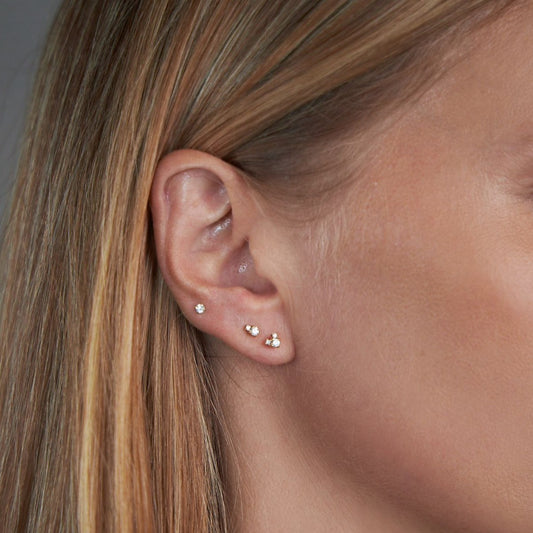
Small earrings is the term for the discreet styles that sit close to the earlobe without hanging, swinging or catching the eye from a distance. At Longvé the category consists of two basic types: studs, which sit fixed through the earlobe with a straight post, and huggies, which are a small closed ring that follows the edge of the earlobe closely. Both are made in 14 karat gold, either gold or white gold, and a large portion of the styles feature diamonds.
Size is what ties the collection together. The styles recur in the steps tiny and small, where tiny is the smallest. A tiny stud with a diamond here has a center stone of 0.015 carat, while a small sits at 0.06 carat. For huggies the difference is the inner diameter of the ring, so a tiny huggie hugs right around the edge of the earlobe, while a small gives a touch more room. This makes it possible to choose exactly the look that suits whether the earring should be almost invisible or just barely visible.
Because earrings are rarely sold in matching pairs for both ears in the same size, most styles can be bought either as a single or as a pair. This is practical if you wear several piercings and want to build up an ear with different sizes, or if you only need to replace the one you lost.
Studs or huggies for everyday wear
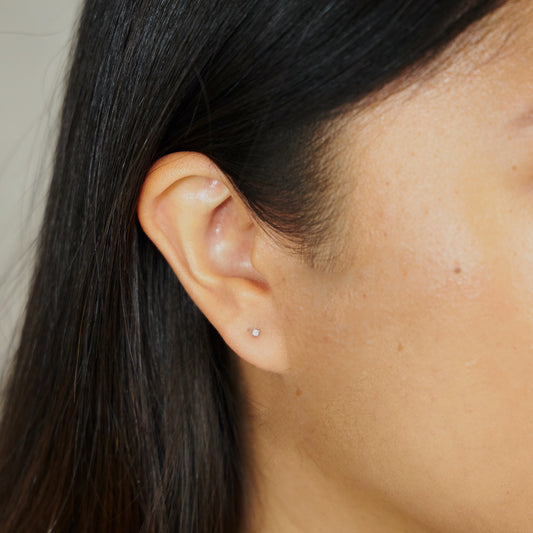
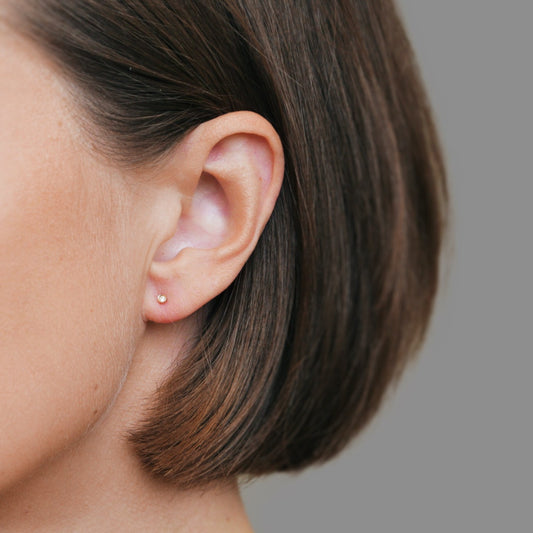
The choice between a stud and a huggie is mostly about how much the earring should be felt and seen. A stud sits still as a single dot on the earlobe and is the most neutral of the two. It is an obvious choice if you want a fixed point that never changes its look, and it is the type most people think of as the classic small diamond earring. Longvé makes the studs in three variations of setting and shape, so there is a range from the very simple to the more striking.
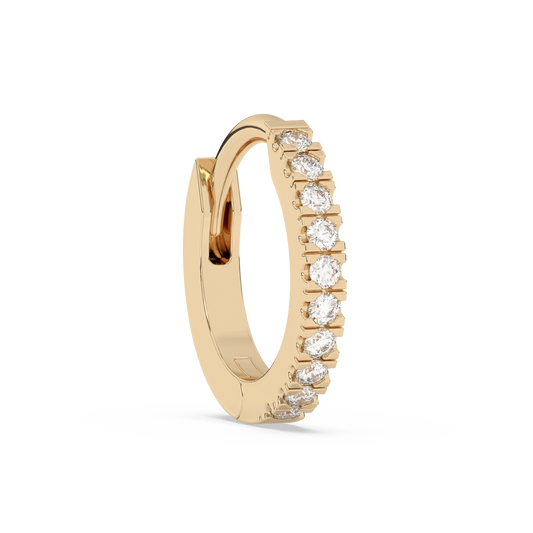
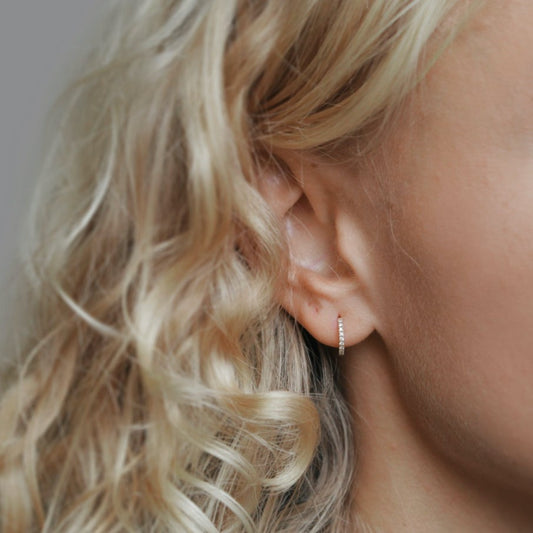
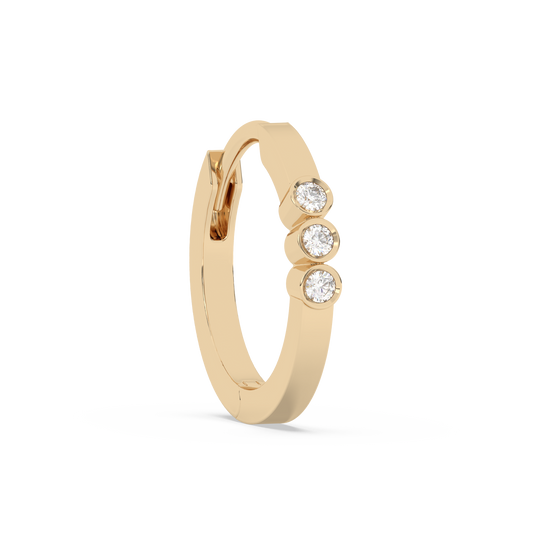
A huggie is a small ring that sits close around the edge of the earlobe, hence the name, which comes from the word for hugging. It gives a little more movement and roundness than the stud, but still stays close to the ear. Among Tiny Huggies and Small Huggies there are both completely smooth versions without stones and styles with diamonds along the front edge. A smooth huggie is the most subdued choice, while a version with small set diamonds gives a discreet sparkle when the light hits.
For those with several piercings, Double huggies are worth knowing. They carry two rows of diamonds instead of one and therefore fill a little more visually, but keep the small ring shape. They work well as the earring that sits in the lowest piercing and carries the rest of the combination.
The difference between bezel and prong on the small diamond styles
The diamond studs at Longvé come in two setting types, and the difference is worth understanding before you choose. A prong setting holds the diamond with small claws that grip the stone and lift it clear of the metal. This lets more light reach the diamond from the sides, so the small prong stud with its 0.06 carat diamond sparkles clearly despite its small size. The claws also make the stone appear a little larger, because the metal around it is minimal.
A bezel setting instead encloses the diamond with a continuous rim of gold all the way around. This gives a calmer, more rounded look, where the stone sits completely level with the setting. It is precisely this closed rim that makes a bezel stud practical for everyday: there are no protruding claws that can catch in hair, scarves or clothing, and the diamond sits well protected. If you want to be able to wear the earring almost all the time without thinking about it, bezel is often the most carefree choice.
Both settings come in both tiny and small and in gold and white gold, so the choice of setting does not lock you into a particular size or metal color.
Fancy cuts give small earrings a different shape
Most small diamond studs are round, but the collection also includes a couple of cuts that break with the round shape without becoming large. A Small pear cut studs is teardrop-shaped and turns the point upward or downward to taste, while a Small emerald cut studs has a rectangular, step-cut surface with calm, broad facets rather than intense sparkle. The emerald cut therefore looks more subdued and graphic than a round diamond of the same weight.
These styles come at 0.10 carat per stone and both as a single and as a pair, as well as in both gold and white gold. They are still small enough to count as discreet everyday earrings, but the shape makes them a slightly more personal choice than the round classic.
Natural or lab-grown diamond
On several of the small diamond styles you can choose between a natural diamond and a lab-grown diamond. A lab-grown diamond is created in a laboratory, but is chemically, physically and optically the same stone as a natural diamond. The difference lies in how it came to be, not in what it is, and with the naked eye you cannot tell the difference between lab-grown and natural diamonds.
In practice this means that a lab-grown version typically gives more diamond for the money in the same size. This is clearly seen on the small prong and bezel styles as well as the pear and emerald cuts, where both kinds are available side by side in the same carat and the same gold color. If you want to read more about how the stones are made, Longvé's article what are lab-grown diamonds goes in depth. If you cannot decide on a metal color, it may help to read what is white gold first.
Gold over gold-plated when they are to be worn daily
Small earrings often become exactly the ones you wear all the time and forget you have on. That is why the material matters more than the size suggests. All earrings in the collection are made in 14 karat gold all the way through, not gold-plated metal with a thin coating that can wear off. This is an important difference for everyday earrings in particular, because a gold plating is typically what causes discoloration and irritation when it wears down and the underlying metal comes into contact with the skin.
14 karat gold is an alloy where gold makes up the majority and the rest is other metals that make the jewelry hard enough for daily use. White gold gets its cool, silver-like color from the composition of the alloy. Because the jewelry is solid gold rather than plated, both studs and huggies can stay in through showering, exercise and sleep without the color changing. If you want to know more about why some earrings discolor the skin, the article why do my earrings turn black explains the mechanism.
How to build an ear with several sizes
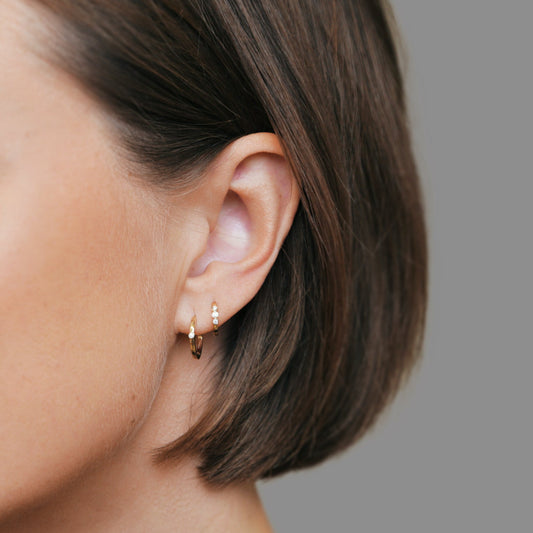
One of the advantages of the styles recurring in tiny and small and being available individually is that you can put several earrings together on the same ear. A typical build is a slightly larger diamond in the lowest piercing and smaller tiny styles going up along the edge, or a smooth huggie in one piercing and a diamond stud in the other. Because everything is in the same 14 karat gold and the same design language, the pieces match no matter how they are combined.
If you have only one piercing, a single small stud or a smooth huggie works fine on its own as the neutral base piece that goes with everything. If you want to see the other styles and metal colors, Longvé's overall category of earrings holds the full selection, while studs and huggies each gather their type. Those looking for the diamond-set styles in particular will find them under diamond earrings.
Which small earrings can you get as your first piercing?
Several people ask whether small earrings can be used for a new piercing. A fresh piercing needs to heal around a post that is suited for the purpose, and it is normally pierced with a simple, smooth stud, not with a ring. A huggie requires a fully healed piercing that you can pass the ring through. Longvé's review which earrings can you be pierced with explains what is needed, and why the choice of metal matters for a new piercing. Once the piercing has healed, you can switch to any of the styles in the collection.