





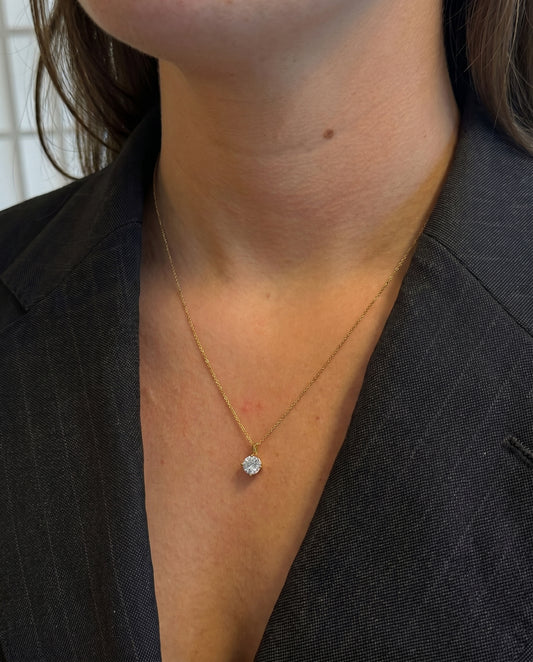

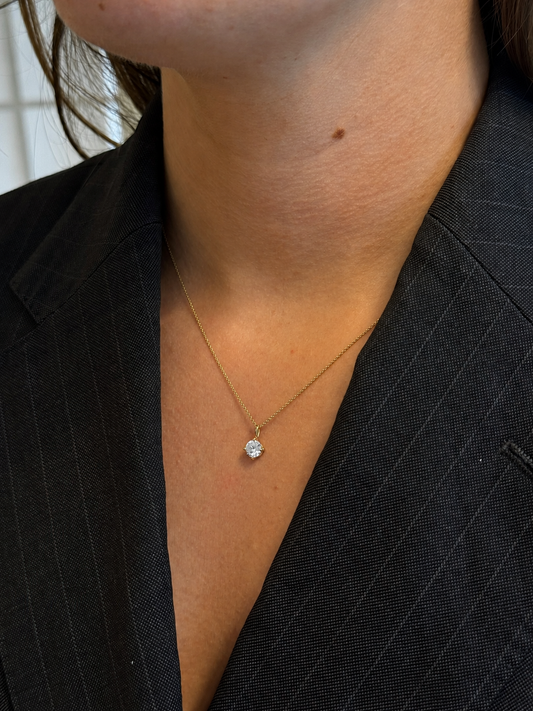

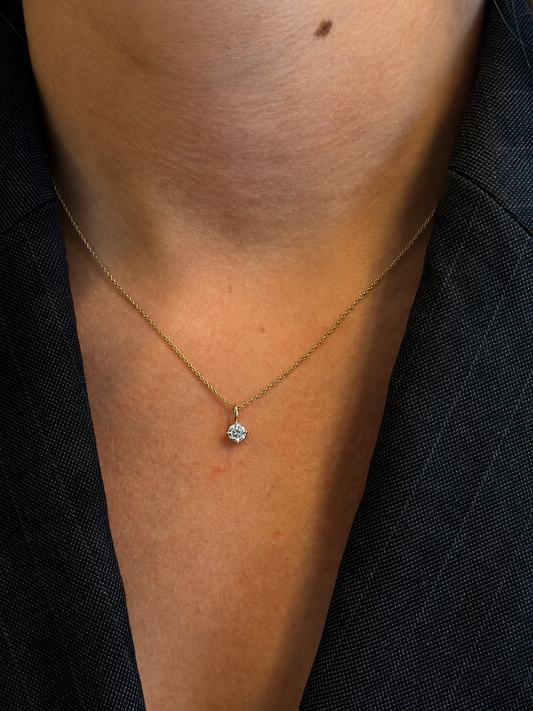
A pendant is loose, a diamond necklace is complete
A pendant is the small part that hangs on the chain: the heart, the letter, the cross or the diamond at the bottom of the V. When you buy a loose pendant, you choose the chain it will hang on yourself, and it is precisely this freedom that makes pendants popular as a gift and for building your own look.
In this collection the pendants are built around 14 carat gold and diamonds, not around gold plating or glass stones. That means two things for your choice: the material keeps its colour and shine for many years, and the diamond is a genuine gemstone with a stated carat weight, not an imitation. You will find solitaire pendants with a single diamond, crosses and letters from A to Z, all in either gold or white gold.
If you want to see the entire range of jewellery that hangs around the neck, it is gathered under pendants and necklaces.
Solitaire pendants with one diamond from 0.10 to 1 carat
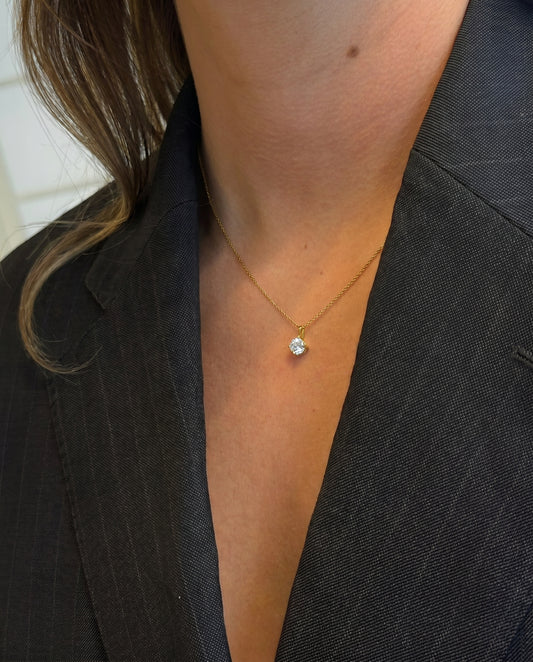
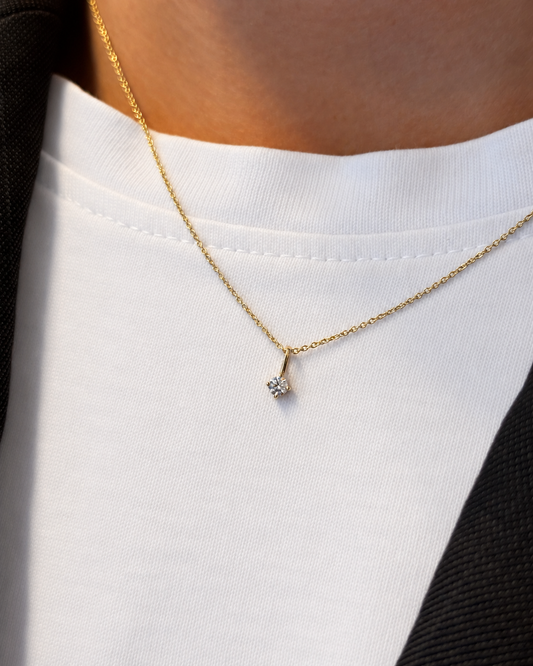
The core of the collection is the solitaire pendant: a single diamond set in a setting that hangs freely on the chain. It comes in a wide range of carat sizes, so you can choose exactly the look and the price level that suits you.
The smallest start at 0.10 carat, where the diamond reads as a discreet sparkle close to the neck. From there the sizes rise through 0.30, 0.50 and 0.70 carat up to a full carat, where the stone becomes a clear eye-catcher. The larger the carat, the more light the diamond catches, and the more noticeably the price rises, because large diamonds are rarer than small ones.
Each step comes in both gold and white gold. If you want to see them gathered in a single stone, they are under solitaire pendant. A solitaire pendant is easy to combine with a ring in the same style, and the same solitaire look recurs in solitaire rings.
Natural and lab-grown diamonds in the same design
Most solitaire pendants come in two versions with exactly the same design: one with a natural diamond and one with a lab-grown diamond. The difference lies in where the stone comes from, not in how it looks.
A lab-grown diamond is grown in a laboratory, but it is chemically and optically the same stone as a natural diamond. It has the same hardness and the same refraction of light, and the difference cannot be seen with the naked eye. The advantage is the price: for the same carat you pay noticeably less for a lab-grown diamond than for a natural one, so you can choose a larger stone for the same amount.
If you want to understand the difference in detail before you choose, the article what are lab-grown diamonds explains how the stones are made. The grown diamonds are gathered under lab-created diamonds, and the natural ones under natural diamonds.
Letter pendants from A to Z
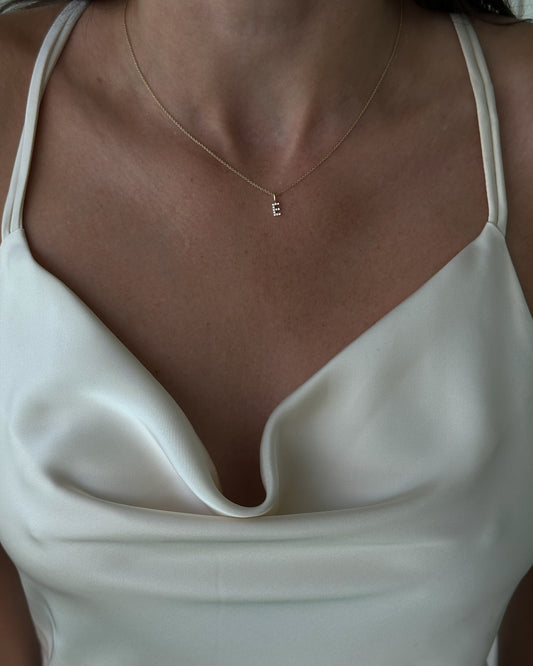
A letter makes the pendant personal without requiring engraving. The letter pendant is available for the whole alphabet from A to Z, each with a small diamond of 0.04 carat, so the initial both stands for a name and catches the light.
It is an obvious choice when the gift should point to a particular person: the recipient's own initial, a child's first letter or a loved one's. The letter comes in both gold and white gold, and in the same two diamond versions as the rest of the collection. If you want to see the letters individually, they are under letters.
Cross pendant in gold with diamond
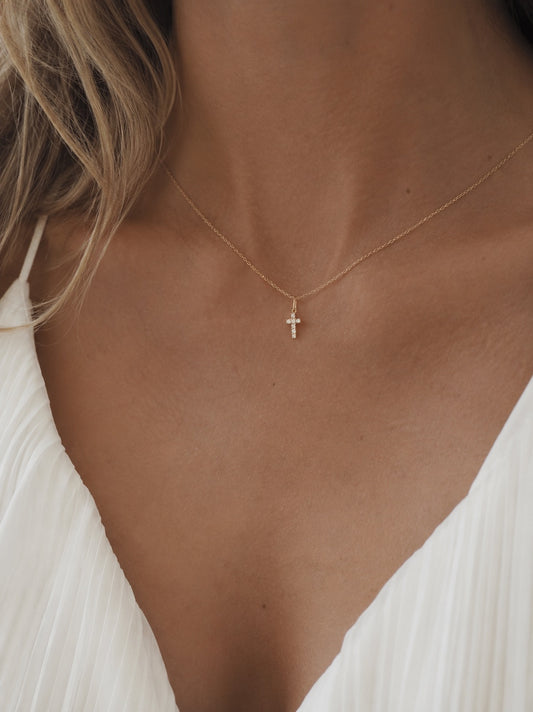
The cross is one of the oldest symbols in jewellery craft and is worn both religiously and as pure style. In the collection it is a small, simple cross with a diamond of 0.02 carat, so the shape is clean and the pendant lies close to the neck.
It comes in gold and white gold and in both natural and lab-grown diamond. A cross in a slender format works well for everyday use, because it is light enough to stay in place and does not take over if you layer several chains together.
Gold or white gold for your pendant
All pendants in the collection come in 14 carat gold, either yellow or white. 14 carat means that the piece consists of 58.5 percent pure gold mixed with other metals that make it hard enough for everyday use. Pure 24 carat gold is too soft for a piece of jewellery you wear every day.
Gold has the warm, classic gold colour. White gold is the same gold alloyed with white metals and usually rhodium-plated, so it gets a bright, silvery surface. The choice is mostly about what suits your skin and what else you wear: if you have silver-toned jewellery or a cool skin tone, white gold fits in naturally, while gold plays up against warmer tones.
If you want to read more about what white gold actually is, what is white gold explains it. If you want to see pendants and other jewellery sorted by metal, they are under gold and white gold.
How to put the pendant on a chain
A loose pendant hangs on a bail or a small loop at the top, and it is threaded onto the chain before you close the clasp. The procedure is simple: open the chain's clasp, pass the chain through the loop on the pendant, close the clasp again, and let the pendant slide down to the centre.
If you have an existing chain with a fixed clasp, that is the route you use. If you buy the chain and pendant separately, check that the thickness of the chain fits the loop: a very thin chain slides easily through a large loop, while a heavy chain may have too large a diameter for a slender pendant. If the clasp is fiddly to get hold of, how to close a bracelet with a clasp helps with the same type of closing mechanism that is also on most necklaces.
Choose the chain length according to where the pendant should rest
The length of the chain determines where on the chest the pendant lands, and that changes the whole look. A shorter chain places the pendant high against the collarbone, while a longer chain leads it down onto the chest.
As a rule of thumb, a chain of around 40 to 42 centimetres rests right at the hollow of the throat, while 45 centimetres is a very common length that places the pendant just below. If you go further down towards 50 centimetres and more, the pendant becomes a clearer eye-catcher on the chest and works well for layering with other lengths. If you want to calculate it precisely, how long should a necklace be goes through the individual lengths.
A heavy pendant with a large diamond pulls a little on the chain and will typically hang slightly lower than the weight of the chain alone. A slender chain highlights a small pendant, while a large pendant requires a chain that can carry it visually.
Pendant as a personal gift
A loose pendant is a gift that can be precisely targeted: a letter for the name, a cross for faith, a solitaire diamond for the occasion. Because you choose the chain and pendant separately, you can build the gift around the recipient instead of buying a ready-made necklace that may have the wrong length.
A small solitaire pendant or a letter hits a calm price level, while a larger diamond lifts it to a striking gift for a milestone birthday or an anniversary. If you are looking for gifts in a particular price range, the jewellery is sorted under gifts under 1500 DKK and gifts under 3000 DKK. If you are in doubt about the choice, a gift card lets the recipient put together the pendant and chain themselves.
How to keep gold and diamond looking nice
A pendant worn close to the skin gradually collects skin oils and cream that settle as a film over the diamond and dull the shine. That is the reason a diamond can look matte even though it is clean and intact.
Gold tolerates ordinary cleaning well: lukewarm water, a drop of mild soap and a soft brush remove the coating, after which you rinse and dry with a soft cloth. White gold is rhodium-plated, and the thin layer can wear down over the years and be restored at a goldsmith. The full procedure is in how to clean jewellery and specifically for the metal in how to clean gold.