What is a solitaire ring?
-

-
A solitaire ring is a ring with a single stone in the center and no other stones around it. The word solitaire literally means "alone," and that is the whole idea: the stone stands on its own, without side stones or pavé along the band to share the attention. The single diamond carries the ring.
That makes the solitaire ring one of the most recognizable ring designs of all. Because there are no other stones, all focus is drawn to the center stone's shape, size and placement, and to how it is set in the setting. That is precisely why it is so often chosen as an engagement ring, where one striking stone is the point.
At Longvé, solitaire rings are built on exactly that principle: a center stone held by a simple setting on a clean band. They come with both lab-grown and natural diamonds in the same design, so the same look can be chosen in either variant.
What sets a solitaire ring apart from other ring types?
The difference lies in the number of stones and in where the eye is drawn. A solitaire ring has one center stone and nothing else. This is in contrast to rings where several stones share the space, and where the overall effect comes from the entire row or wreath of diamonds rather than from one stone alone.
A trilogy ring, for example, has three stones in a row, one center stone flanked by two side stones, where the three together make up the design. A round trilogy lab-grown diamond ring in 14K gold has 2.4 carats in total spread across the three stones. An eternity ring has small diamonds all the way around the band, and a pavé ring has many small diamonds set closely in the surface. In all of those cases there is not one carrying stone, but many.
The solitaire ring goes the opposite way. All the setting and all the design are arranged to hold and highlight the single stone.
How the setting holds the stone in place
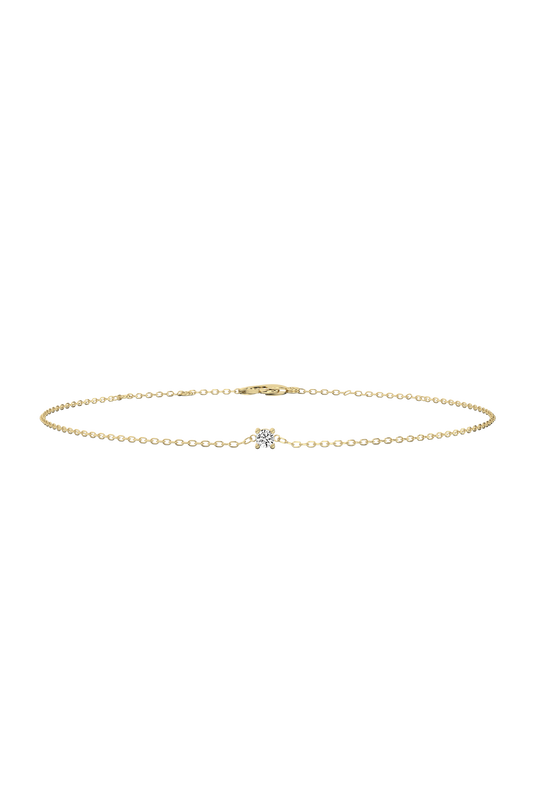
The setting is the part of the ring that grips the diamond and holds it in place. On most solitaire rings this is a prong setting, where small metal prongs are bent down over the edge of the stone and lock it in place. The prong setting lifts the stone clear of the band and lets light reach it from several sides, because the metal covers as little of the diamond as possible.
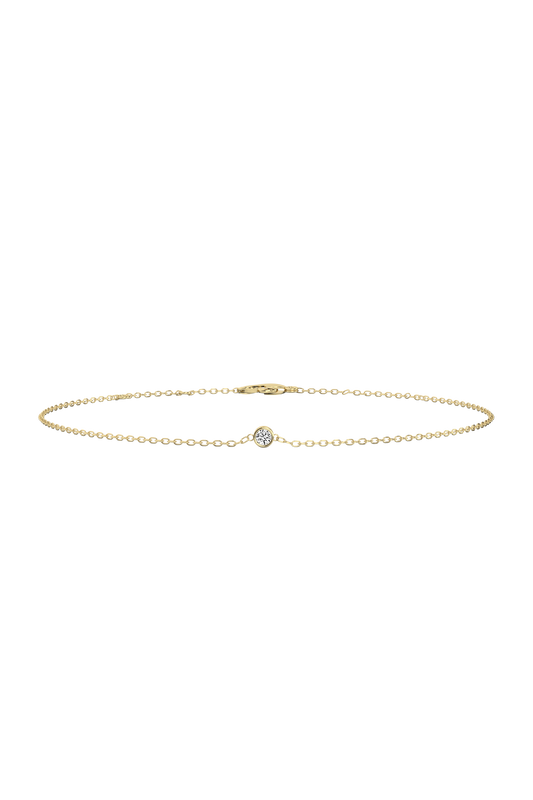
Another option is a bezel setting, where a rim of metal goes all the way around the stone and encloses it. It sits lower and more protected, and the rim gives a softer, more rounded look. Longvé offers solitaire rings with a bezel setting in several sizes, including a medium solitaire bezel ring in 14K gold, where the rim closes tightly around the diamond.
The choice between prong and bezel is mostly about how the ring should look, and how high the stone should sit. A prong setting shows more of the stone from the side, while a bezel gives a smoother surface without protruding prongs.
How the cut changes the solitaire ring's look
Because the solitaire ring only has the single stone, the diamond's cut matters a great deal for how the ring looks. The cut determines the stone's outline and the way light plays within it. Longvé's solitaire rings come in several cuts, and each shape gives its own look.
Round and oval
The round brilliant cut is the most classic. It is symmetrical all the way around and reflects a great deal of light, which makes it an obvious choice when the stone should stand out clearly. A round solitaire ring in 14K gold is an example of the classic look.
The oval cut has the same facet pattern as the round, but in an elongated shape. The elongated contour gives a slightly softer and more stretched look than the round, and it is found among Longvé's oval solitaire ring in 14K white gold.
Pear, cushion and marquise
The pear-shaped cut combines a round end with a point at the other, so the stone gets a teardrop-shaped outline. The cushion shape is square with rounded corners and a soft, pillow-like look. The marquise cut is elongated and pointed at both ends and visually takes up a lot of room on the finger relative to its weight.
All three are available as solitaire rings at Longvé, including a pear solitaire ring, a cushion solitaire ring and a marquise solitaire ring, all in 14K gold or white gold. The shape is the single factor that most often determines whether a solitaire ring is experienced as classic, soft or more striking.
Gold or white gold for the solitaire ring
Longvé's solitaire rings are made in 14K gold and 14K white gold. The metal does not change the solitaire principle itself, but it affects how the stone appears. Gold gives a warm contrast to the diamond, while white gold is closer to the stone's own tone and lets it blend more with the band.
Most solitaire designs are available in both metals, so the same cut and setting can be chosen in the color that best suits the rest of the jewelry the ring will be worn with. If you want to see what is available in the light variant, Longvé gathers it under white gold.
Lab-grown or natural diamond in a solitaire ring
A solitaire ring can be set with either a lab-grown or a natural diamond, and at Longvé most solitaire designs are available in both variants. A lab-grown diamond is a real diamond, grown in a laboratory, and it has the same chemical composition and the same optical properties as a natural diamond. Both types are carbon crystallized under high pressure, and both rate 10 on the Mohs scale, which is the highest a material can reach.
Because the two types look the same in the finished piece, the choice comes down to which stone should sit in the setting. The solitaire look itself is the same regardless of the stone's origin. If you want to see the selection grown in a laboratory, Longvé gathers it under lab-grown diamond rings, while the natural ones are found under natural diamonds.
A solitaire ring is thus not defined by what kind of diamond it carries, but by the fact that it carries one stone alone, set in a simple setting that lets the stone be the ring's focal point.